We use cookies to make your experience better. To comply with the new e-Privacy directive, we need to ask for your consent to set the cookies. Learn more.

Top 3PL Safety Issues (and Solutions)
November 4, 2026
|
Categories: Blogs, Ergonomics, Manufacturing, Material Handling, Efficiency, Safety
Operating a 3PL (third-party logistics) warehouse requires extensive planning: You’re managing the physical inventory for multiple businesses, while promising to provide the communication, tracking, and delivery that their end users expect. To stay profitable, you need to manage your available space perfectly, which means sizable investments in material handling equipment.
But while your long-term goal is to cut the fat and run as efficiently as possible, safety is a crucial consideration at every point — and not just because of OSHA compliance. Put simply, safety and efficiency go hand-in-hand: If you ignore potential hazards, you can expect higher turnover rates and built-in inefficiencies that reduce throughput.
If you’re planning a 3PL business, you should understand how safety issues can impact your bottom line. Here’s an overview of five common problems — along with solutions that can actually extend your service offerings and keep your 3PL business growing.
1. Order Picking Ergonomics
3PL order picking is a big subject, and designing a strategy that’s both scalable and auditable isn’t easy. For the purposes of this article, we’ll assume that you’ve found core picking methods that work for your business (if not, be sure to read: Warehouse Picking Systems: 6 Strategies and the Tools That Support Them).
But it’s important not to hyperfocus on just the core picking strategy. Every warehouse order execution system should treat ergonomics as a priority.
Order picking tends to require heavy lifting or manual movement of materials; without oversight, it’s also a common source for repetitive motions and prolonged positioning (sitting or standing without changing posture).
In other words, it’s a shortcut to musculoskeletal injuries, which can quickly introduce unexpected expenses. The Institute of Medicine has estimated the annual costs of work-related musculoskeletal disorders to be between $45 and 54 billion (including compensation, lost wages, and decreased productivity).
OSHA recommends incorporating interventions that address ergonomic hazards before those hazards cause injuries. Where possible, you need to provide equipment that adapts the work to the worker.
The good news is that with order picking, that’s relatively straightforward: Minimize manual lifting wherever possible. When lifting is inevitable, provide equipment that keeps the load at an appropriate height to minimize bending, twisting, and lifting.
Products to Consider: Scissor Lift Tables, Tilt Tables, and Mobile Lifts
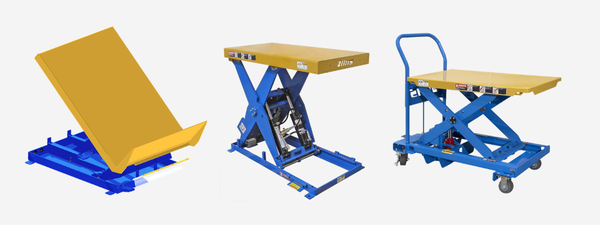
Lift Tables are platforms that raise and lower heavy loads. They’re essential for positioning work to the worker at the proper height, and with service capacities of up to 10,000 lb (4536 kg), they’re capable of handling virtually any type of product or material.
When work needs to be handled at an angle, BHS Tilt Tables can tilt to a full 90 degrees, preventing risky movements for 3PL warehouse staff. Mobile options are available for transporting bulk containers, and all units are made with powder-coated steel for maximum durability.
Tilt Tables and Lift Tables can be outfitted with special tabletops (such as roller conveyors) to meet the needs of your operation. Browse our full selection of lifting and positioning equipment.
2. Palletizing Ergonomics
Ergonomics are particularly important when your employees are loading or unloading pallets. Without proper safety measures, workers may lift heavy loads from near the floor — and that’s unnecessarily stressful for the human body.
Promote good postures in the warehouse with pallet-specific material handling equipment. We recommend self-leveling pallet lifters, which keep the load precisely within the worker’s “golden zone,” the area near the core of the body.
Products to Consider: Self-Leveling Pallet Carousel and Skid Positioner (PCSP-S)
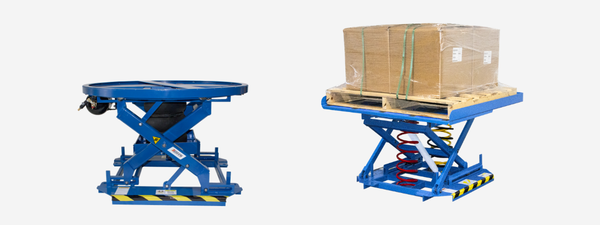
The BHS Pallet Carousel & Skid Positioner (PCSP-S) makes loading and unloading pallets and skids safe, simple, and efficient. The turntable rotates a full 360°, requiring less worker movement while improving productivity.
The turntable top is equipped with easy turning, anti-friction bearings allowing users to spin loads, so workers don’t need to walk around it. A self-leveling mechanism automatically positions pallets at a comfortable, ergonomic position as products are added or removed.
Related: Warehouse Ergonomics: Order Picking and Pallet Building Safety Tips
3. Traffic Management
As your operation grows, so does the need for traffic management. More order pickers and forklifts moving through the aisles means a greater potential for an accident — and accidents involving material handling equipment can be incredibly dangerous.
According to the Bureau of Labor Statistics, more than 84 workers died from forklift-related incidents in 2024. Some of those accidents occurred despite proper precautions on part of the lift truck operators; the trucks had audible backup alarms, and the drivers followed their training.
Products to Consider: Structural Bollards (SB) and Structural Barrier Rails (SBR)
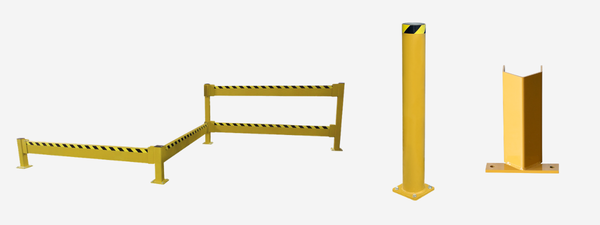
BHS Structural Bollards (SB) shield critical corners, equipment, and structural supports from industrial vehicle collisions. Built from heavy-duty structural steel pipe with an OSHA-compliant yellow powder-coat finish, each bollard absorbs impact energy to protect building infrastructure.
Structural Barrier Rails (SBR) are available in single-rail and double-rail configurations. Designed for quick installation, they bolt directly into concrete flooring to create impact-resistant pedestrian pathways and workstation perimeters.
4. Battery Room Hazards
Oversights in the battery room can lead to injuries, property damage, and unnecessary limitations on your fleet’s capacity. There’s a reason that OSHA has relatively specific standards for battery handling, and if your warehouse relies on lift trucks, any time that you spend improving your battery room will be time well spent.
As a leader in forklift battery handling, BHS provides complete solutions for warehouses, including custom-designed battery rooms with level floors, adequate ventilation, and specialized equipment that keeps operators safe during high-throughput change-outs.
Products to Consider: Battery Change Solutions, Battery Wash Cabinets, and Emergency Wash Equipment
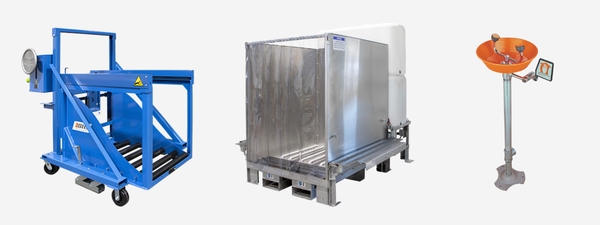
BHS offers dedicated battery handling systems to match any operational footprint. Facilities managing smaller fleets can eliminate manual pulling risks with portable, push-around units like the Manual Transfer Carriage (BTC-MPPA) or the Powered Transfer Carriage (BTC-MPP). For operations that handle frequent battery swaps, the Walkie Transfer Carriage (WTC) mounts to an existing pallet truck for powered extraction.
High-throughput, multi-shift 3PL facilities can scale up to fully dedicated systems like the Single Level Operator Aboard Battery Extractor (BE-SL) to manage high-volume change-outs from a centralized location.
For regulatory compliance and chemical safety, pair charging areas with Battery Emergency Eye and Eye/Face Wash Stations (BEW) and acid-neutralizing Battery Spill Kits (SK). Dedicated Battery Wash Cabinets (BWC) clean corrosive residue and recycle runoff water, containing hazardous materials away from the warehouse floor.
5. Lack of Hazard Communication
Hazard communication is essential, but it consistently ranks among the top 10 most frequently cited OSHA standards. Visible safety warnings give staff immediate, actionable information, identifying where PPE is required, marking restricted zones, and so on.
Along with visible warnings, facilities must provide structured training on ergonomic lifting techniques and proper personal protective equipment (PPE) usage. Be sure to keep records of every training session — if you don’t maintain a paper trail, you’ll have a tough time proving compliance during an audit.
Products to Consider: Signage and Posting Kits (SP)
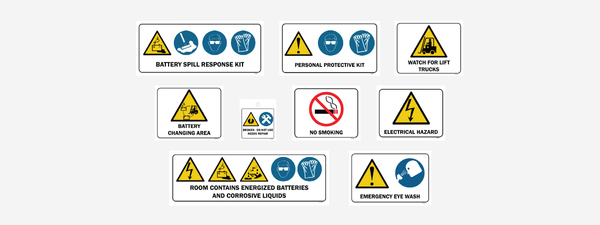
BHS Signage and Posting Kits (SP) include nine signs for the battery room, clearly identifying the location of emergency equipment to allow for a faster response.
All BHS signs come with an easy-to-clean laminated surface and double-sided tape affixed to the back. Signs can also be screwed into the wall if desired. Signs are printed on intermediate vinyl mounted on .020-thin PVC. Large symbols help to overcome language barriers.
Building a Compliant, Safe, and Efficient 3PL Facility
Investing in dedicated ergonomic equipment protects your bottom line by keeping order throughput predictable. When your staff works safely, they’re working efficiently — and you’ll be able to maintain long-term fulfillment contracts with confidence.
To discuss custom material handling solutions for your 3PL operation, call 1.800.BHS.9500 to speak with a member of our team.
Discuss custom material handling solutions for your 3PL operation
Call 1.800.BHS.9500 to speak with a member of our team.
