We use cookies to make your experience better. To comply with the new e-Privacy directive, we need to ask for your consent to set the cookies. Learn more.

Building a Custom Lift Table for Automated Material Handling Flow
November 11, 2026
|
Categories: Blogs, Case Studies
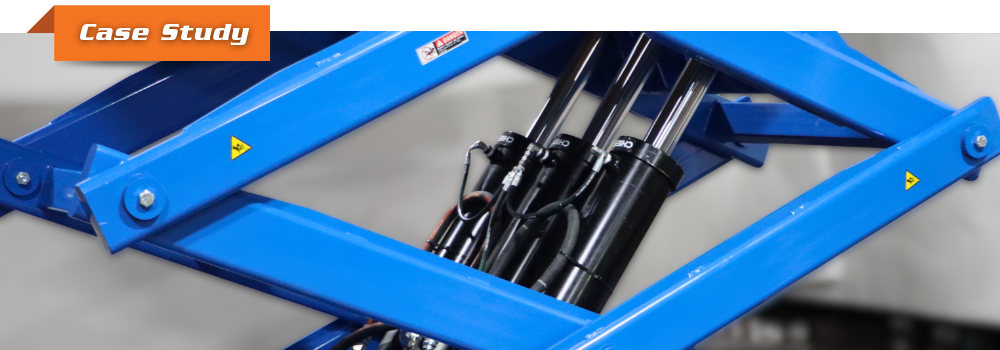
Production lines depend on material handling equipment, and all mechanical equipment eventually requires replacement.
But what happens if you rely on a highly specialized piece of material handling equipment for your operations — and the manufacturer no longer offers that solution?
The Problem: A Failing Lift Table and a Specialized Material Flow
In 2025, we received a request from a family-owned business that manufactures architectural, commercial, and residential wood doors. The company has developed a custom material flow that allows for high consistency and excellent quality.
For architectural doors, that process looks like this:
- Roller conveyors feed a 6-foot stack of doors onto a pit-mounted lift table.
- The lift table raises the stack to a target height (109.5 inches).
- An overhead crane positions itself directly above the stacked load. Hoists lift a single door from the top of the stack.
- The overhead trolley moves the individual door to the center trimmer feed conveyor.
- Releasing mechanisms lower the door onto the trimmer line. The empty crane returns to the lift table for the next unit.
The process starts with the pit-mounted lift table, which had a few issues; the old unit swayed and bounced when handling heavier doors (such as lead-lined and composite cement units). When handling smooth doors, a slight tilt or drop could cause them to physically slide off the load.
Those issues could be resolved with some engineering tweaks. But critically, the lift table’s manufacturer no longer offered that unit — and while lift tables are a common sight in warehouses, pit-mounted lift tables with a 10,000-lb. capacity are much less common.
In July 2025, the company reached out to a BHS dealer to find a solution.
The Solution: A Custom Double-Scissor Lift Table Designed for Consistency
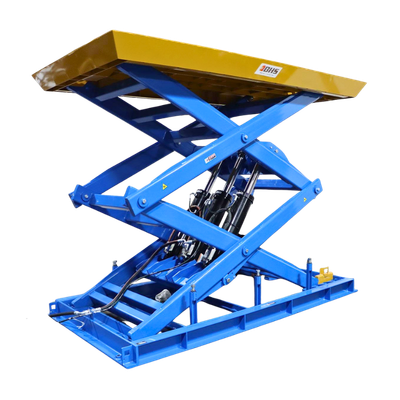
Initially, the customers were looking for a basic replacement, but BHS engineers identified several key deficiencies in the older lift table’s design:
- The original unit had undersized lifting cylinders, which weren’t appropriate for the rated 10,000-lb capacity.
- Light-duty scissor legs further compromised the table’s structural stability.
- Aging components prevented the table from maintaining the precise elevation required to keep the overhead crane cycle moving.
Our team recommended a custom BHS Lift Table with a dual-scissor design that would be more appropriate for the job at hand.
Initially, the customer had concerns that the dual-scissor design was introducing an unnecessary point of failure. The lift would need to be absolutely precise in order to prevent line jams and other production issues — and a dual-scissor configuration meant more moving parts, which might mean more swaying or bouncing.
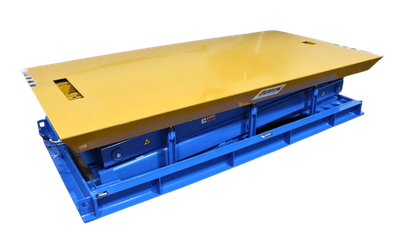
But BHS engineers evaluate every aspect of MHE specifications and material handling workflows before making recommendations. By showcasing a BHS Lift Table in action, our team was able to demonstrate the benefits of the design — namely, better consistency when operating under high loads.
The new product was a 10,000-lb capacity Lift Table with a 60" by 120" top, with a fully-raised height that would precisely feed the overhead crane trolleys.
The Result: Increased Equipment Uptime and More Efficient Production Lines
After receiving approval, the Lift Table went to production. BHS clearly communicated production times and worked with the client to hit the target install date.
Following installation, the new pit-mounted lift table immediately resolved the facility's material flow bottleneck. Heavy-duty engineering completely eliminated the bouncing and dropping issues of the older equipment.
The dual-scissor configuration maintained perfect stability under massive product loads. That directly translated to increased uptime, and in June 2026, the company added an additional Lift Table with the same design.
BHS can help your operation build towards a consistent, safe, and efficient material flow.
Contact BHS or call 1-800-BHS-9500 to learn more.
