We use cookies to make your experience better. To comply with the new e-Privacy directive, we need to ask for your consent to set the cookies. Learn more.

Types of Freight Elevators and Alternative Material Lifts
October 21, 2026
|
Categories: Blogs, Ergonomics, Manufacturing, Material Handling, Efficiency, Logistics, Conveyors
As more warehouses go vertical, freight elevators can seem like more of an asset. You need to move products, materials, and people between levels; if your building already has an elevator shaft, why not use an elevator for that job?
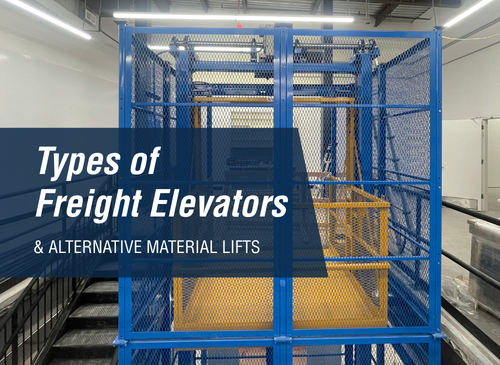
As we’ll discuss in this article, there are alternatives — namely, Vertical Reciprocating Conveyors — that can provide the same benefits as a freight elevator at a fraction of the cost. VRCs, which are sometimes referred to as freight lifts, are designed to move materials, not people. That distinction makes them a better option for most industrial facilities.
But with that said, freight elevators have their place in the logistics landscape. Here’s everything you need to know to find a freight transport option for your operation.
Types of Freight Elevators: A, B, C1, C2, and C3
Freight elevators are classified by how they’re loaded — note that this is how they’re loaded, not just how much they can carry. While total capacity is important, loading classifications are slightly more complicated:
- Class A Freight Elevators: General Freight Loading: Distributed loads enter the car manually or with hand trucks. No single piece of freight may exceed 25% of the rated capacity, and load weight distributes evenly during loading and unloading.
- Class B Freight Elevators: Motor Vehicle Loading: Designed exclusively to carry automotive vehicles, light trucks, or passenger cars up to the rated capacity of the elevator.
- Class C1 Freight Elevators: Industrial Truck Loading (Carried Onboard): Power industrial trucks drive directly onto the elevator platform to load and unload cargo. The combined weight of the truck and payload must not exceed the rated capacity, and the vehicle travels inside the elevator car.
- Class C2 Freight Elevators: Industrial Truck Loading (Not Carried Onboard): Powered industrial trucks drive onto the platform solely to load or unload cargo, then exit before the elevator moves. The platform accepts a total static load up to 150% of the rated capacity during the loading phase.
- Class C3 Freight Elevators: Heavy Concentrated Loading: Engineered for concentrated unit loads where industrial trucks do not drive onto the platform. The car handles single, heavy items equal to the full rated capacity without requiring vehicles to enter the cab.
The bottom line: The way that you load the unit matters. Without a strict, clear, and comprehensive loading strategy, you run the risk of overloading your freight elevator.
And since elevators can carry human passengers, they have requirements for regular maintenance and inspections. Those requirements apply regardless of the frequency of human travel (so you can’t bypass inspections by simply insisting that people “don’t usually ride the elevator”).
Cost-Effective Alternatives to Freight Elevators
All five loading classifications are defined within — and governed by — the ASME A17.1-2025: Safety Code for Elevators and Escalators. With all classifications, there's an assumption that human passengers will be part of the cargo that moves between floors.
But in many warehouses, that’s not necessary — the job of the lift is simply to move materials or equipment. When that’s the case, VRCs (freight lifts) can cut through quite a bit of red tape.
ASME A17.1-2025 is a 500-page document, and it details strict requirements for braking mechanisms, load limits, allowable stresses, and more. That’s necessary because human passengers need to be protected, and the best way to provide that protection is to build multiple layers of redundancy into the equipment.
Vertical Reciprocating Conveyors must still follow strict safety specifications to keep operators safe, but they don’t require nearly the same level of redundancy and oversight. Instead of the elevator code, VRCs follow ASME B20.1, the standard for conveyors and related equipment.
Related: Vertical Reciprocating Conveyors: Frequently Asked Questions
Using VRCs to Manage Materials and Equipment
Vertical Reciprocating Conveyors are an excellent alternative to freight elevators, and in many cases, they can be installed in existing elevator shafts. BHS provides two models, which can be outfitted for various use cases.
- Mechanical Straddle Vertical Reciprocating Conveyors (VRC-MS) move full pallets, loaded carts, materials, and equipment with up to 100 feet (30.5 meters) of vertical travel. With standard travel rates of 28 feet (8.5 meters) per minute and load capacities of up to 6,000 pounds (2,722 kilograms), BHS Mechanical VRCs can be outfitted with high-speed drive systems, ramps, slide gates, and other features to match the application.
- Hydraulic Cantilever Vertical Reciprocating Conveyors (VRC-HC) are designed for space efficiency, with a two-post cantilever design and travel speeds of up to 25 feet (7.6 meters) per minute. Features a lifting capacity of 3,000 pounds (1,361 kilograms) and two carriage options sized for common materials (including pallets, carts, and AGVs).
To learn more about our VRCs, supported loading patterns, and other options, read: The VRC Buyer’s Guide Choosing a Vertical Reciprocating Conveyor.
Need to find vertical material handling solutions for your facility? We’re ready to help. Contact the BHS sales team at 1.800.BHS.9500 to discuss options or request a quote online.
