We use cookies to make your experience better. To comply with the new e-Privacy directive, we need to ask for your consent to set the cookies. Learn more.

Vertical Reciprocating Conveyors: Frequently Asked Questions
July 29, 2026
|
Categories: Blogs, Ergonomics, Manufacturing, OSHA, Material Handling, Conveyors
Vertical Reciprocating Conveyors (VRCs) are industrial lifts that move materials vertically between levels; they’re functionally different from freight elevators, which lift people.
We’ve designed cost-effective VRCs for warehouses, distribution centers, and various other multi-floor facilities to boost productivity and maximize floor space. Below, we’ll answer some of the most common questions we receive about VRCs.
If you’re looking for material handling solutions for your operation, we can help you explore VRCs and other options. Compare VRC options online or call 1.800.BHS.9500 to get started.
Is a VRC similar to a freight elevator?
Yes, but with a key difference: People cannot ride on a VRC.
Per ASME A17.1, the Safety Code for Elevators and Escalators, as quoted in the U.S. Access Board Accessibility Standards, a freight elevator is "used primarily for carrying freight and on which only the operator and the persons necessary for unloading and loading the freight are permitted to ride."
That’s crucial, because elevators must have redundant safety features, and they need to be rigorously inspected and tested. VRCs and other material handling equipment have much less stringent standards — and that makes them less expensive to operate and maintain.
VRCs can often be installed in existing freight elevator shafts, but they’re fundamentally more versatile. If you’ve got a facility with mezzanines or multiple stories, a VRC can slot into your material handling strategy.
Do VRCs need to meet any standards?
Yes, VRCs must be built to meet ANSI/ASME B20.1: Safety Standard for Conveyors and Related Equipment, which enforces appropriate safety controls given the intended application of the equipment.
As is the case with other types of material handling equipment, the ANSI requirements for VRCs are aligned with OSHA standards. In other words, a non-ANSI-conformant VRC might present a compliance issue.
All VRCs manufactured by BHS meet and exceed ANSI/ASME standards.
What types of materials can a VRC transport?
A VRC can handle anything that fits into the lift platform; BHS models have capacities of up to 6,000 lbs. That includes loose materials, heavy equipment, and fully loaded pallets.
Even if the VRC isn’t the right option for your facility, our team can help you find ways to handle materials and improve efficiency. We’ve worked with dealers and their end users to create material handling solutions for raw materials, pallets, crates, and specialty components.
What is the difference between hydraulic and mechanical VRCs?
BHS offers two primary drive systems to match different operational requirements:
- Hydraulic Cantilever (VRC-HC): The VRC-HC uses fluid compression to generate lifting power. It’s ideal for two-story applications with travel heights up to 15 feet and support for loads of up to 6,000 pounds (2,722 kilograms).
- Mechanical Straddle (VRC-MS): Utilizing an electric motor and heavy-duty chain system, mechanical lifts are designed for higher vertical reaches — up to 25 feet (7.62 meters) — and faster travel speeds of roughly 28 feet (8.5 meters) per minute. These units are better suited for high-cycle, multi-story applications.
If you’re not sure which option will work best for your operation, send us a message. Our team will work with you to understand your business’s workflows and the unique features of your facility.
What VRC loading patterns are available?
To ensure the lift integrates seamlessly into an existing workflow, BHS VRCs support several common traffic patterns:
- Z-Pattern: Materials enter one side of the carriage and exit the opposite side.
- C-Pattern: Loading and unloading occur on the same side of the carriage.
- 90-Degree (L) Pattern: The load enters the front and exits through either the left or right side.
Four-way loading patterns are also possible, though they’re much less common since four-way access requires the installation of guide beams.
To learn more about how load patterns influence material handling efficiency, read: Vertical Lift Traffic Patterns: Planning for VRC Material Flow.
Can we customize a BHS VRC to meet the needs of our operation?
Yes, we offer a number of options for our standard units to provide customization while controlling lead times.
- Carriage sizes can be altered to meet specifications.
- Units can be configured with vertical gates, slide gates, ramps, and other features to improve accessibility.
- Motors can be upgraded to boost travel speeds.
- Custom paint colors are available for all units.
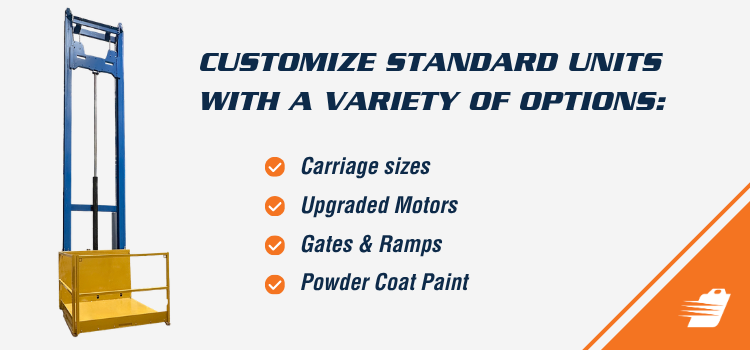
This isn’t a comprehensive list of customizations — if you can dream it, we can build it. Speak with a member of our sales team or request a quote online to learn more.
Can a VRC be installed quickly?
Standard VRC models from BHS are designed to minimize lead times by removing the lengthy custom-design phase. The Hydraulic Cantilever VRC even ships fully assembled, requiring only securement to the floor and connection to a power source to begin operation.
Once again, this is why VRCs are generally preferable to freight elevators: While any piece of material handling equipment requires safety considerations, VRCs don’t require frequent inspections and maintenance (since they don’t carry personnel).
Can a VRC be integrated into an automated conveyor line?
Absolutely! VRCs integrate well with highly automated material handling flows. We can design VRCs to support an unmanned product flow with roller conveyors, sorting systems, and automated guided vehicles (AGVs).
What information should I collect before buying a VRC?
To ensure that your VRC provides a return on investment, you’ll need to know the following:
- Materials: Collect information about the physical dimensions and weight of materials to estimate an average load.
- Frequency: Will you use the VRC constantly as part of an automated/manual material flow, or will you use it occasionally to move stock or equipment from mezzanines? Remember, load cycles are usually more important than the total capacity of the unit.
- Load Process: Will you load the VRC with a lift truck, pallet jack, or via another method? This can impact the loading pattern.
- Accessibility: Will you need controls at every level, or just on the ground floor? Where will the unit be installed, and how will it affect vehicle traffic? Make sure to also measure floor-to-floor height and overhead clearance at the highest level to ensure that the VRC will fit.
- Special Requirements: If you’re evaluating VRCs for a highly specific use case, you’ll need to work with a partner that can provide appropriate customizations (for example, using spark-proof or medical-grade materials).
Once again, we strongly recommend working with an experienced material handling partner. Vertical Reciprocating Conveyors can improve efficiency right away — but as with all MHE, they need to be implemented in a way that makes sense for your operation.
What are some important VRC safety features?
BHS material lifts integrate multiple redundant safety mechanisms to satisfy ASME B20.1 conveyor standards and isolate warehouse personnel from vertical travel hazards.
Core & optional safety features include:
- Velocity Fuses and Drop Locks: Hydraulic units utilize specialized velocity fuses within the cylinders to instantly lock fluid flow and freeze the carriage if a hose breaches. Hydraulic and mechanical units feature drop locks that automatically engage to anchor the carriage to the guide masts if a lift chain breaks or loses tension.
- Smart Gate Interlocks: Landing swing or slide gates feature electromechanical interlocks combined with gate position sensors. The system cuts power to the lift motor if any gate is left open.
- Proximity Sensors and Enclosed Carriages: Integrated proximity sensors ensure the carriage stops precisely flush with upper floor levels to eliminate loading gaps and trip hazards. Fully enclosed platform walls protect workers from falling objects in compliance with OSHA 1910.28 standards.
BHS VRCs can also be equipped with audible alarms and flashing lights, further improving safety and compliance.
Does OSHA require annual inspections for VRCs?
No, although annual maintenance checks are recommended — all material handling equipment should be regularly checked, and since VRCs are usually integral to material flows, they certainly deserve some regular attention.
But VRCs are not elevators, so they generally don’t require inspections or expensive maintenance. Be sure to ask your material handling partner for maintenance schedules and tips.
Does a VRC require a pit or a vacant elevator shaft?
No. VRCs can be installed in unused elevator shafts, but they can also be installed directly onto the slab surface. To ensure that units will be installable in your facility without major modifications, reach out to our sales team to discuss the use case.
Can a VRC be installed outdoors?
Yes, if there’s no suitable space for installation indoors. However, customization may be necessary to ensure that the unit is weatherproof.
Any other tips for implementing a VRC into my facility?
If you work with a qualified MHE partner, you can hit the ground running, so to speak — a VRC should immediately improve workflows and keep materials moving.
However, be prepared to make changes where necessary. Ask operators for their insights after a few days. If necessary, you may need to make optimizations within the staging area (for example, you might refine vehicle paths or establish procedures for the VRC’s operation).
Remember, VRC operators should be trained for the task — that’s true for all types of material handling equipment, but it’s particularly important for machines that operate between levels due to the risks of falling objects. It’s a good idea to train all workers on VRC operation so that they’re comfortable with the equipment and aware of the inherent risks.
Finally, make sure that VRCs have appropriate signage. Units should be clearly marked as “Material Only — No Riders,” and you may need additional signage to establish the travel paths of loading equipment (such as fork trucks).
To learn more about VRCs from BHS, Inc., browse our products online or call the BHS sales team at 1.800.BHS.9500.
