We use cookies to make your experience better. To comply with the new e-Privacy directive, we need to ask for your consent to set the cookies. Learn more.

Material Handling Ergonomics: Using the Golden Zone for Safer Lifting
February 17, 2026
|
Categories: Blogs, Ergonomics, OSHA, Material Handling, Safety
Warehouse managers often focus on equipment solutions to ergonomics issues. And while there's good reason to invest in assistive lifting equipment, there are cheaper and easier ways to get big returns. The number one way? Teach workers to lift in the ergonomic "golden zone" or "safety zone."
But when lifting, where is the safety zone? It's the area closest to the lifter's body, and between the shoulders and knees. When lifters keep heavy items within this ergonomic power zone, they face a reduced risk of back injuries, strains and sprains, and other overexertion injuries.
The Dangers of Poor Lifting Technique
The Bureau of Labor Statistics reports that overexertion, repetitive motion, and bodily conditions — a category that includes lifting heavy objects — were the leading causes of serious workplace injury in 2023 and 2024. This predictable and preventable risk of injuries makes heavy items an obvious target for managers looking to improve safety.
Reducing the number of musculoskeletal injuries is simple in theory but requires constant attention in practice. Here are some lifting techniques and tips for staff to keep them healthy.
-
Warm up: Stretch your back and legs before the lift.
-
Know the object's weight: Avoid loads heavier than a single person can safely lift. If it's too heavy for one person, ask for help or use lifting equipment.
-
Make sure your pathway is clear: The duration of the lift will be shorter if you can take a direct and clear route to the destination.
-
Lift in the golden zone (also called the lifting power zone or the safe lifting zone), keeping objects close to the body, mid-thigh to mid-chest.
-
Avoid repetitive motions: Performing the same lift over and over leads to a higher risk of strain and muscle pulls. Rotate employees to give overused muscle groups a break.
-
Lift with your legs: Even when moving a load diagonally, pivot with your feet instead of twisting your back. Maintain straight spine alignment at all times.
Managers who emphasize these safe lifting tips will see a reduction in preventable injuries and enjoy productivity benefits. And remember, employers should not only teach these strategies, but periodically check to make sure they are continually being followed.
Finding the Golden Zone
The golden zone in ergonomics refers to the area nearest to the core of your body between your shoulders and knees. Even better, the Occupational Safety and Health Administration (OSHA) recommends sticking to an area between the mid-thigh and mid-chest to allow employees to lift with even more ease.
Safe lifting is largely a question of body mechanics. Lifting heavier items in this zone reduces stress on the back and lets employees exert less effort. That means their chances of injuries go down and their energy levels go up. That's good for morale and productivity.
Lifting Equipment Still Has a Role
The safe lifting zone and safe lifting techniques go a long way toward reducing workplace injuries, but mechanical aids are still necessary in some situations. For instance, a recycling center where workers repeatedly empty heavy trash cans will need a bin dumper or the turnover rate due to injury will be unacceptably high. Warehouses always need pallet jacks, hand trucks, and forklifts to handle heavier loads, regardless of the operator's level of physical fitness.
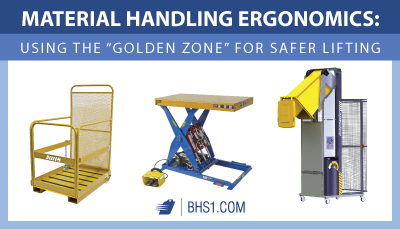
The winning combination for a safe work environment is to use assistive equipment to bring loads to the golden zone and then let employees take over. This could take the form of lift tables raising a pallet to a more comfortable height or a work platform raising an employee so he can pick an item without lifting the load above his shoulders.
Modern warehouses have more tools than ever to avoid costly injuries to staff. Pallet carousels and tilt tables make warehouse work safer and easier than ever. Just don't forget that education and knowledge of the golden zone are also part of your toolbox.
References:
Bond, Josh. "Ergonomics: Finding and maintaining the golden zone." MMH. Peerless Media LLC, 1 Feb. 2014. Web. 12 Sept. 2017.
"Ergonomics eTool: Solutions for Electrical Contractors." OSHA. Occupational Safety and Health Administration, U.S. Department of Labor, n.d. Web. 12. Sept. 2017.
“Occupational Injuries and Illnesses Resulting in Musculoskeletal Disorders (MSDs)" BLS. Bureau of Labor Statistics, U.S. Department of Labor, 1 May 2020. PDF. 11 Sept 2025.
"Proper Lifting Techniques." Ergo-Plus. Ergonomics Plus, Inc, n.d. PDF. 12 Sept. 2017.
