We use cookies to make your experience better. To comply with the new e-Privacy directive, we need to ask for your consent to set the cookies. Learn more.

Industrial Dock Equipment for Distribution Centers: A Buyer’s Guide
August 26, 2026
|
Categories: Blogs, Ergonomics, Manufacturing, Material Handling, Efficiency, Logistics, Safety
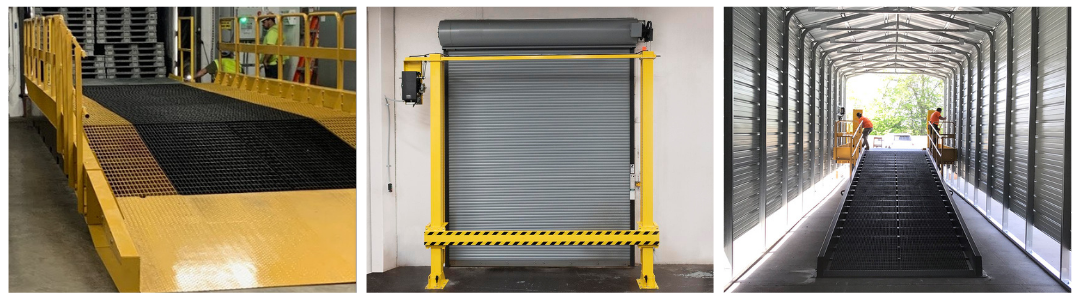
If you’re sourcing industrial dock equipment, you know that loading areas are pretty much the key for operational success. They’re also a concern from a safety perspective: A full 25 percent of industrial warehouse accidents take place at the loading dock, according to EHS Today.
Forklift roll-offs, pedestrian falls, and ergonomic hazards translate to serious liabilities — not to mention lost time and damaged products. Operations managers must balance safety compliance with high-speed material flow.
Upgrading your loading dock equipment can help you find that balance. Here’s everything you need to know when upgrading your manufacturing facility, distribution center, or other industrial operation.
Industrial Dock Equipment: Staying Safe at the Dock Edge
When you’re outfitting a dock with material handling equipment (MHE), safety comes first. Let’s take a moment to discuss compliance.
Occupational Safety and Health Administration (OSHA) standard 1910.28 mandates fall protection for any unprotected edge four feet or higher above a lower level. Loading docks perfectly fit that description.
Safety protocols require robust physical barriers to separate pedestrians from lift trucks and secure the dock edge when loading doors remain open. Those are common-sense precautions — but they’re absolutely necessary for keeping your operation safe.
BHS engineers heavy-duty steel safety barriers to absorb impacts, control traffic, and prevent catastrophic falls at the warehouse loading dock:
Powered Dock Gates (PDG-120-120)
High-visibility barriers prevent dock edge accidents and forklift roll-offs. These barriers are capable of stopping 10,000 pounds of force at 4 miles per hour, stopping reversing forklifts before accidents occur.
BHS dock safety gates feature two steel uprights supporting a horizontal barrier with a reinforced structural channel. A high-visibility yellow finish instantly alerts staff to the danger of a vacant loading dock, while the security gate bar prevents roll-off — even if forklift operators miss the visual warning.
Structural Bollards (SB)
Steel surface-mount bollards protect vulnerable building architecture, dock control systems, and structural columns from forklift collisions.
Place these solid steel posts strategically around the warehouse interior to shield costly infrastructure. Installing bollards near the dock edge also physically prevents forklifts from accidentally driving off standard-height drop-offs.
Powder-coated “safety yellow” finishes ensure maximum visibility for forklift drivers operating in fast-paced environments.
Structural Barrier Rails (SBR)
High-visibility steel rails establish dedicated traffic lanes. Separating pedestrian walkways from the active routes used by Order Pickers and automatic guided vehicles drastically reduces the chances of a collision.
Modular, drop-in rail designs allow maintenance teams to remove sections temporarily for equipment access, providing flexibility without compromising overall safety compliance.
Base plates are pre-drilled for ground anchors or mounting hardware. Custom designs are available for more permanent installations.
Solutions for Expanding Dock Capacity and Infrastructure
Modern warehouse management often demands dock space — sometimes, more dockspace than a typical industrial property has. Heavy-duty steel ramps and platforms can help to expand infrastructure for loading operations while controlling costs (and in some cases, minimizing code compliance issues via non-permanent installation).
Consider pairing modular dock platforms with heavy-duty dock bumpers, a vehicle restraint system, and dock seals and shelters to create a fully functional, weatherproof loading bay.
Modular Loading Dock Platforms (MLDP)
A complete MLDP allows you to construct a brand new loading bay entirely from scratch — avoiding conventional construction delays entirely. The heavy-duty steel decking supports maximum-capacity forklift loads.
Bolt-together construction requires no permanent alterations to your building architecture, making the MLDP an ideal asset for a leased industrial distribution center.
Platforms can be customized with integrated dock levelers. Facilities further enhance the MLDP by adding heavy-duty bumpers, vehicle restraints, and dock enclosures to create a fully functional, weatherproof loading bay.
Loading Dock Ramps (LDR-12032-25)
Standard 48-inch high concrete docks cannot physically service smaller last-mile delivery vehicles like transit vans or box trucks. Retrofitting a conventional bay with a steel Loading Dock Ramp provides immediate, safe access for these lower vehicles.
The gradual incline allows workers using pallet jacks or hand trucks to transition smoothly from the warehouse floor directly into the delivery van. Steel grating provides all-weather traction to prevent slip-and-fall accidents during inclement weather.
Dock Ramps (DR)
Moving heavy material handling equipment safely between different facility elevations requires permanent, high-capacity infrastructure. Fixed steel Dock Ramps (DR) provide ground-to-dock access for continuous, heavy-duty forklift traffic.
Transition plates at the top and bottom of the ramp eliminate jarring bumps, protecting sensitive electronics and fragile inventory during transport.
Yard Ramps (YR)
High-volume operations frequently need to unload freight far away from the primary building. Facilities access trailers and rail cars from anywhere within the truck court by deploying a heavy-duty portable Yard Ramp.
Solid steel approach plates help absorb impact at the base while open steel grating provides maximum traction on the remainder of the ramp. This fully portable ramp can withstand loaded forklifts without suffering damage thanks to its all-steel construction.
The 36-foot ramp gradually ascends from ground to truck for ergonomic loading and unloading. A hydraulic hand pump controls thehttps://na.bhs1.com/dockmaster-hydraulic-bin-dumper-27-tip-height.html height and two solid rubber tires allow the ramp to move to where it’s needed. An optional tow bar can hitch the base of the ramp to a lift truck for relocating the ramp.
Rubber tires provide mobility across rough asphalt, turning any open yard space into a fully operational loading dock.
Streamlining Material Handling and Ergonomics
Moving bulk materials, waste, and recycling from the dock floor into outdoor dumpsters requires specialized ergonomic solutions. Overexertion consistently ranks as the leading cause of disabling injuries across all sectors.
Bin Dumpers provide a solution — and while they’re often associated with waste management, they’re an excellent addition to any loading dock.
Dockmaster Hydraulic Bin Dumper (DM0700)
Workers safely empty heavy bins, drums, and boxes from the elevated dock directly into ground-height containers using the Dockmaster.
Industrial hydraulic cylinders provide the lifting power, completely eliminating the need for manual lifting and twisting. The operator simply loads the bin, presses a button, and the machine tips the load smoothly over the dock edge.
Dockmaster units integrate seamlessly into high-volume logistics centers and food manufacturing plants to systematically prevent musculoskeletal injuries and maintain compliance with the Food Safety Modernization Act during waste handling.
From cardboard recycling and organic waste to industrial scrap, the Dockmaster provides reliable operation with a duty cycle of 22,000 lb (10,000 kg) of material per charge or 11,000 lb (5000 kg) per hour on continuous charge.
Custom Engineering for Specialized Operations
Standard catalog equipment occasionally falls short of a facility's unique architectural geometry. Deep-freeze cold chain storage, multi-level Automated Storage and Retrieval Systems (AS/RS), and hazardous material processing areas present complex logistical hurdles. Custom dock equipment provides an immediate alternative when off-the-shelf products cannot meet strict operational demands.
BHS utilizes extensive engineering expertise to design and manufacture custom solutions for complex environments. BHS sales engineers provide the product knowledge necessary to configure the exact industrial dock equipment required to secure your facility and accelerate your material flow.
For additional guidance and resources, read:
- Choosing a Dock Ramp: 3 Factors to Consider
- Loading Dock Safety for Forklift Operators
- Safety Tips for Operating Lift Trucks On and Around Dock Ramps
- Dock and Yard Ramps Expand Access at the Loading Dock
- The Warehouse Dock Ramp Buying Guide
- OSHA Guidelines for Driving Forklifts on Ramps and Grades
- Custom Loading Dock Platforms: 5 Common Use Cases
Discuss your unique loading requirements with BHS
Contact BHS or call 1-800-BHS-9500 to request more info.
