We use cookies to make your experience better. To comply with the new e-Privacy directive, we need to ask for your consent to set the cookies. Learn more.

How to Build the Ideal Tugger Cart System
August 13, 2025
|
Categories: Blogs, Manufacturing, OSHA, Material Handling
When properly implemented, a tugger cart system can dramatically improve route efficiency — saving your operation hundreds of thousands of dollars and increasing throughput almost instantaneously.
The key term, of course, is “when properly implemented.” Tugger systems can navigate tighter aisles, move more products, and maximize precision, but only when they’re designed to lift the specific operational constraints of a given facility. Just as you couldn’t install a Vertical Reciprocating Conveyor (VRC) overnight and get an immediate return on investment, you can’t simply purchase a fleet of mother-daughter carts and expect results.
For that reason, we strongly recommend working with a material handling partner when choosing tugger cart systems and designing routes. But by understanding some of the basics of system design, you can make planning conversations more productive.
Modular Tugger Carts for Warehouse Logistics
A core principle in modern equipment design is modularity: deconstructing a larger system into smaller, independent, and interchangeable units. That’s key to a successful tugger cart system.
The benefits of a modular approach will directly impact your return on investment:
- Flexibility and Customization. Modular design allows carts to be precisely configured for various load types, shapes, and sizes. Adaptability is critical in dynamic environments where product lines or handling requirements change frequently; you can make changes without redesigning an entire system from the ground up.
- Future-Proofing Operations. As your operational needs evolve, modular systems can evolve with you. Instead of purchasing entirely new machinery to handle a new product, you can add, swap, or reconfigure carts.
- Alignment with Lean Principles. The flexibility of modularity directly supports the goals of lean manufacturing and Just-in-Time (JIT) delivery. It means less waste and a faster, more agile response to production line demands.
At BHS, our approach is rooted in providing deeply customizable solutions that are truly modular. By offering custom designs — and engineering carts from scratch, when necessary — we provide systems tailored to a client's specific and evolving needs.
Choosing the Key Components for Your Tugger Train
Constructing an optimal tugger cart system involves carefully selecting its core components. Each element must be matched to your specific application.
Modular and Custom Carts
The foundation of a modular system is the cart itself. The ideal model depends on your facility, from navigating tight corners to maintaining tracking fidelity in long trains. BHS offers a range of solutions.
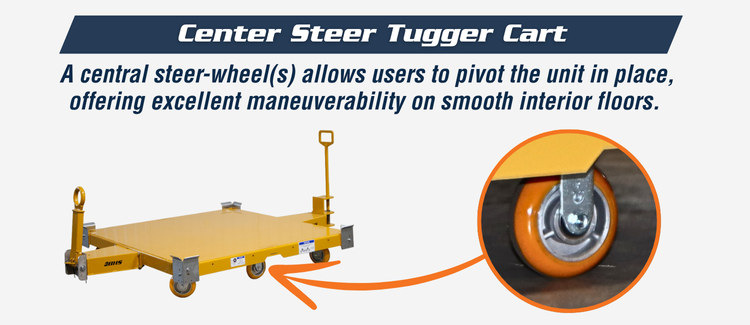
Center Steer Tugger Carts (TT-CS) feature a central steer-wheel that allows users to pivot the unit in place, offering excellent maneuverability on smooth interior floors.
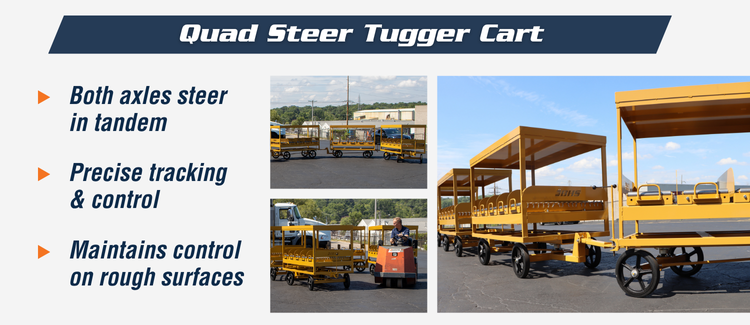
For long picking trains or milk-run systems, Quad Steer Tugger Carts (TT-QS) are engineered so both axles steer simultaneously, ensuring precise tracking and control, even on rough surfaces or slopes.
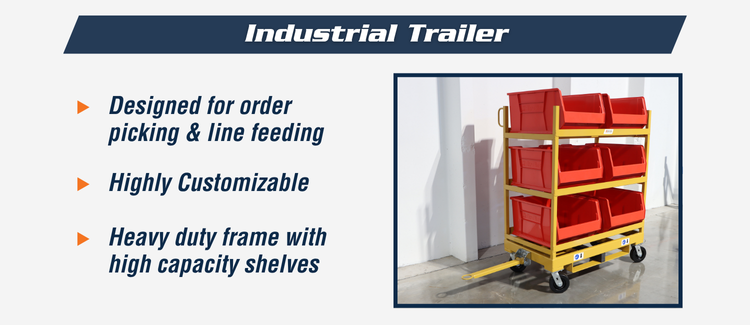
For order picking and line feeding, versatile Industrial Trailers (IT) can be customized with shelves and other features to suit unique material handling requirements.
Mother-Daughter Cart Systems
For complex workflows, a Mother-Daughter cart system provides an efficient solution. This setup involves a larger "mother" cart designed to carry multiple smaller "daughter" carts.
The daughter carts can be detached at various workstations while the mother cart continues its route, creating a continuous and flexible material flow.
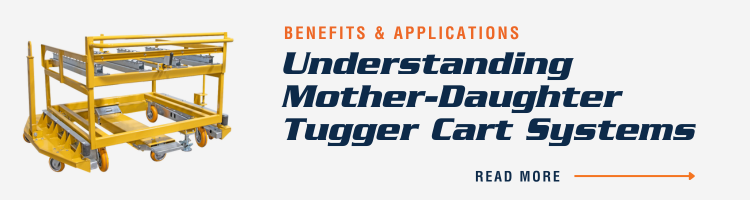
To learn more, read: Understanding Mother-Daughter Tugger Car Systems: Benefits and Applications.
Electric Tuggers
The electric tugger is the engine of the system, providing the motive force to pull the train of connected carts. When selecting a tugger, you must evaluate its towing capacity, turning radius, cycle capability (to ensure that it can handle an appropriate number of runs per workday) and footprint. Make sure that the entire train will have sufficient clearance from work areas (such as packing stations).
You might also opt for warehouse robotics to move the tugger train from station to station — provided that your carts are compatible. BHS Tugger Carts and Industrial Trailers provide exceptional compatibility with electric tuggers as well as automated guided vehicles (AGVs) and autonomous mobile robots (AMRs).
Building Your Ideal Tugger Train System with BHS
The most effective tugger cart systems are fully integrated solutions where the carts, tugger, and routes are all optimized to work together while providing sufficient clearance for workstations and travel paths. Achieving this level of optimization requires a partner with deep engineering expertise.
BHS, Inc. leverages state-of-the-art manufacturing technology to engineer and build Tugger Carts that are precisely tailored to our clients' operational challenges. Whether you need to add highly maneuverable, low-footprint carts to an existing system or plan a fully customized Mother-Daughter system, our team can deliver a solution designed for maximum efficiency, safety, and long-term value.
To start building a tugger cart system for your facility, browse our full line of Industrial Carts. To learn more about custom solutions, contact the BHS sales team at 1.800.BHS.9500 or start a quote online.
