We use cookies to make your experience better. To comply with the new e-Privacy directive, we need to ask for your consent to set the cookies. Learn more.

Modular Vs. Custom Material Handling Equipment: Comparing Manufacturing Lead Times
August 12, 2026
|
Categories: Blogs, Manufacturing, Material Handling, Construction, Efficiency, Industry Knowledge Base
At BHS, we’ve built our brand as a leading manufacturer of ergonomic material handling and industrial equipment. We operate a 148,000-square-foot facility in St. Louis, Missouri, featuring the latest in CNC machining, robotic welders, and laser technology.
And since we operate as a manufacturer — rather than simply selling to manufacturers — we understand some processes cannot be simplified with off-the-shelf products. Sometimes, custom material handling equipment is essential, and our engineering team regularly works with businesses to find novel solutions.
When ordering custom material handling equipment, however, manufacturing lead times can be a significant concern. Today, we’ll discuss our approach to custom manufacturing.
We'll also explain why many of our products feature modular designs to help bridge the gap between custom manufacturing and standard production timelines.
Custom Material Handling Equipment: Factors That Drive Lead Times
Custom manufacturing has a mixed reputation. If you’re building a lean facility, you probably need equipment that accommodates the workflows you’ve created — but to many managers, “custom" means “be ready to wait up to 52 weeks for delivery.”
We solve that problem by addressing the factors that lead to bloated manufacturing lead times:
- Initial Engineering and Modeling: Designing a product requires extensive CAD modeling, structural calculations, and stress testing. BHS utilizes pre-tested baseline configurations, allowing engineers to modify existing structural frames rather than starting from scratch. Crucially, we communicate with the dealer and end user to make sure that we understand the intended process before we suggest features or specifications.
- Custom Tooling and Component Procurement: Unique equipment can mean specialized hydraulic cylinders, non-standard steel profiles, or unique steering components. Those components are often sourced, which introduces a third party (and additional bottlenecks) into manufacturing. BHS eliminates third-party supply chain dependencies by performing fabrication in-house.
- Compliance and Safety Certification: Custom machinery must comply with regulatory benchmarks such as OSHA standards or ASME safety codes for conveyors. Because BHS designs equipment with these regulations built into the foundational architecture, we’re able to avoid lengthy compliance review cycles.
All of this can be summarized in one word: experience. When you’re working with a partner that has a substantial history as a custom equipment manufacturer, lead times aren’t so oppressive.
Modular Designs Cut Manufacturing Lead Times While Accommodating Unconventional Workflows
Ultimately, custom manufacturing will always take more time than standardized manufacturing. That’s why we’ve built modularity into our product line.
Here are a few examples of designs that allow for flexible implementation — and a fast return on investment.
Modular Order Picker Platform (OPPM)
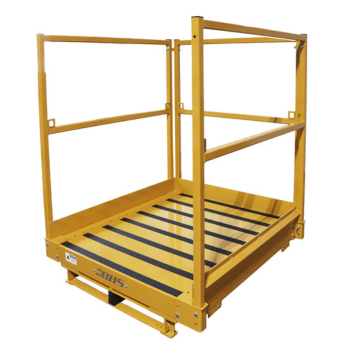
The OPPM attaches directly to an order picker forklift to expand the workspace for warehouse operators, allowing them to handle bulkier goods safely. For oversized inventory, opt for the Order Picker Furniture Platform (OPPMF), which has an extended base for furniture order picker trucks.
How Modularity Makes It Better
Adjustable fork guides slide to fit different types of lift trucks in a mixed fleet. Removable side rails and adjustable shelves let facilities adapt the platform to their current inventory.
For instance, an operator can mount high-capacity shelves to sort small parcels during peak e-commerce season, or remove the shelves entirely to create a wide, open deck for bulkier loads.
Modular Order Picker Cart (OPCM)
How Modularity Makes It Better
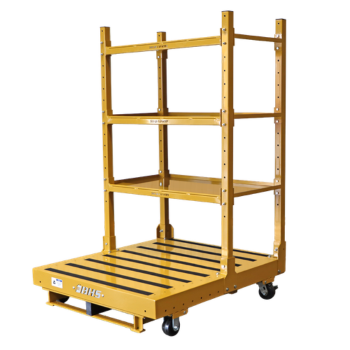
Bolt-on components allow workers to alter the cart setup using standard hand tools.
A facility moving mixed freight can install heavy-duty side guarding panels and multi-tiered shelving to keep loose packages secure. If the workflow shifts to transporting large palleted loads, the operator can strip the cart down to a flat steel platform in minutes.
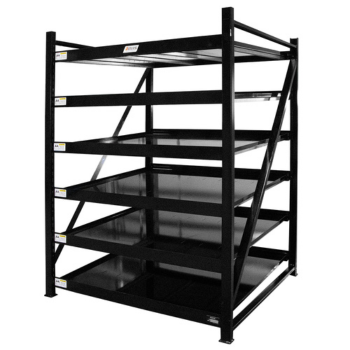
Modular Storage Rack (SKU: 26301246)
How Modularity Makes It Better
A toolless slot-and-tab system replaces traditional assembly hardware, allowing quick adjustments to the shelving layout. Placing the shelves completely flat provides standard warehouse storage for boxed inventory.
If the workflow changes to high-velocity parts picking, workers can angle the shelves forward to create a gravity-fed flow rack that automatically slides products to the front picking edge.
Work Faster, Safer, and Smarter with BHS
So, do you need custom material handling equipment, or will a modular design provide the same utility (and potentially more flexibility)?
Our engineers can help you make the right decision for your operation. Whether you need a quick tweak to an existing design or an entirely new solution to a novel problem, we have the knowledge, experience, and infrastructure to deliver equipment within your production schedule.
Find the Best Fit with BHS
Contact BHS or call 1-800-BHS-9500 to request more info.
