We use cookies to make your experience better. To comply with the new e-Privacy directive, we need to ask for your consent to set the cookies. Learn more.

How VRC Installation Impacts Your ROI
August 19, 2026
|
Categories: Blogs, Ergonomics, Manufacturing, OSHA, Material Handling, Efficiency, Safety, Conveyors
If you’re looking for ways to store more products and cut transportation costs, look up: Warehouses with mezzanines (or multiple levels) are simply a better investment, once you bypass the logistical challenges of vertical storage.
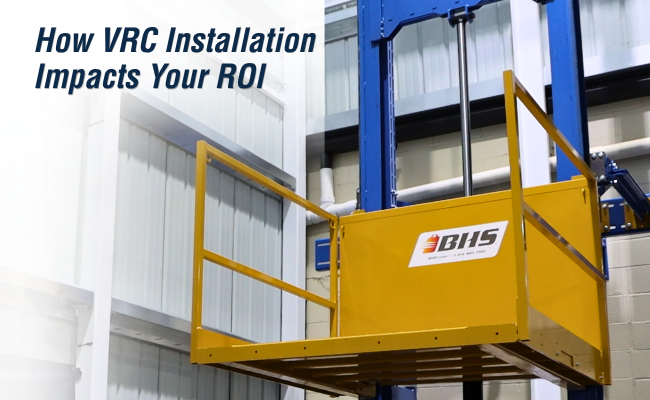
Of course, that’s a big caveat. Moving materials and products between levels requires a well thought-out material handling strategy. A Vertical Reciprocating Conveyor (VRC) can provide a quick return on investment for several key reasons:
- A VRC isn’t a freight elevator. Freight elevators are notoriously expensive; they require regular upkeep to meet ASME A17.1 codes governing human transport. Material lifts — like VRCs — don’t carry human passengers, so they’re subject to ASME B20.1, a far less strict standard.
- VRCs are relatively inexpensive to install and operate. Bypassing passenger elevator requirements reduces initial installation, operating, and ongoing maintenance costs by up to 75%.
- VRCs save space. VRC systems require significantly less valuable floor space than traditional incline conveyors. That’s more space for inventory.
Those are the primary selling points for VRCs, and we’ve made those points in other articles — but today, let’s dive into some additional numbers that show how Vertical Reciprocating Conveyors save money while making the most of warehouse floorspace.
To determine how a VRC can benefit your facility, call 1.800.BHS.9500 or request a quote online.
VRC Installation: Fast, Simple Deployment
Field installation labor for large material handling lifts can cost $10,000 per day. BHS mechanical VRCs are pre-assembled and designed for fast deployment — 2.5 to 5 days, which is about half of the typical installation timeline for a freight elevator.
Shortening the installation timeline saves facilities between $25,000 and $50,000 in immediate labor costs. And we continuously work on design improvements to cut those timelines even more.
For example, BHS VRCs now feature heavy-duty integrated shipping wheels, which allow a single forklift driver to maneuver the unit horizontally through a facility directly to the installation point.
Vertical Reciprocating Conveyors Save Space on Day One
Average US industrial warehouse rental rates currently sit at $10.18 per square foot. Building upward with vertical mezzanines multiplies your storage capacity without forcing your operation to lease additional industrial real estate.
To put that another way, you'll instantly claim more inventory space out of your existing building footprint. BHS VRCs can be installed in several ways to make the most of your space:
- Pit-mounted VRC designs sit flush with the floor, allowing seamless ground-level loading with standard pallet jacks. A pit-mounted design is an excellent option if your building already has an elevator shaft.
- Floor-mounted configurations utilize a compact ramp instead. By choosing a ramp, you won’t need to cut into a concrete foundation.
Regional building environments can also play a role in your VRC’s design. BHS engineers can provide custom seismic analysis down to the specific street address to ensure compliance with local safety codes.
Safe Operation for Long-Term Compliance
We’ve already covered the most obvious safety advantage of VRCs: They don’t carry human passengers, so they’re fundamentally safer than traditional elevators. But compared with other material handling solutions, VRCs still come out on top. Using high-mast forklifts to move pallets between levels introduces severe workplace hazards. According to OSHA data, forklifts cause about 34,900 serious injuries and 85 workplace fatalities every year.
VRCs provide some benefits here, too:
- Tip-over incidents represent the single most common cause of forklift fatalities, accounting for 42% of fatal incidents. Shifting multi-level material movement to dedicated VRCs eliminates forklift tip-over hazards and load-drop liabilities entirely.
- Built-in engineering controls protect your workforce and your inventory while the VRC’s operating. Automatic emergency braking mechanisms prevent the carriage from dropping if a cable fails.
- Engineered access controls allow for safer operation. Optional safety features include audible alarms and flashing lights at each level.
Explore Vertical Reciprocating Conveyors from BHS
Find the right Vertical Reciprocating Conveyor for your operation. Options from BHS include:
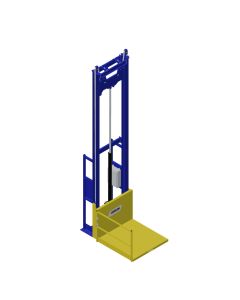
BHS Hydraulic Cantilever VRC (VRC-HC)
They're shipped fully assembled to allow for fast onsite installation immediately upon delivery. The compact two-post cantilever frame takes up minimal floor space while supporting a variety of loading patterns.
Pallet loads and heavy equipment move efficiently between levels at a lifting speed of 25 feet (7.62 meters) per minute. It's an efficient drive system that safely spans multi-level facility layouts — up to a 16-foot (4.9-meter) vertical range.
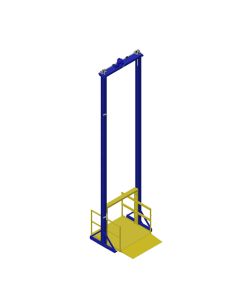
BHS Mechanical Straddle VRC (VRC-MS)
They're engineered specifically for high-speed operations, utilizing a two-post straddle design to distribute weight evenly between opposing columns. Guide structures align seamlessly with existing building layouts to optimize continuous material transit
Low-maintenance mechanical drive systems handle continuous throughput across heavy shifts. Materials travel smoothly at a rate of 28 feet (8.5 meters) per minute across an extended 100-foot (30.5-meter) transport range.
Learn more about the differences between mechanical and hydraulic VRCs.
Find Material Lifts for Your Operation
Maximizing throughput requires an investment in equipment that balances space, speed, and safety. A dedicated material lift can provide that balance — provided that it’s engineered for the job at hand.
Call the BHS sales team at 1.800.BHS.9500 or request more info online to discuss the right vertical reciprocating conveyor configuration for your operation.