We use cookies to make your experience better. To comply with the new e-Privacy directive, we need to ask for your consent to set the cookies. Learn more.

Panel Dollies Vs. Panel Carts: Choosing Sheet-Handling Equipment
February 11, 2026
|
Categories: Blogs, Ergonomics, Manufacturing, OSHA, Material Handling, Efficiency, Safety
You need to move sheets of drywall, plywood, glass, or other fragile materials throughout your worksite — and while you could rely on manual labor, that’s a bad long-term practice.
Manual material handling is inefficient and potentially dangerous; that’s why organizations like the Canadian Centre for Occupational Health and Safety (CCOHS) recommend using “drywall carts or another appropriate cart" for all sheet materials.
Your primary MHE options include panel dollies and panel carts. A panel dolly is a compact, handle-less unit that supports the weight of a load while requiring the operator to manually balance the materials. Panel carts are self-supporting and have integrated handles, which usually means that they have higher capacities than dollies.
In this article, we’ll compare the two categories of MHE to help you determine which investment offers the best return for your operation. To discuss custom options with a member of our sales team, call 1.800.BHS.9500 or request a quote online.
Panel Dollies and Panel Carts: What’s the Difference?
Before we dive into features, let’s define some terms:
- A panel dolly is typically a low-profile base (or channel) on wheels that requires the operator to manually balance the load.
- Panel carts are self-supporting vehicles equipped with integrated handles and vertical frames.
Generally speaking, panel dollies are only appropriate when space is extremely limited and you don’t need to move panels on a regular basis. That’s because dollies still rely on the physical labor of the operator — and that’s an invitation for musculoskeletal injuries.
As NIOSH materials note:
“Workers who handle drywall sheets are at high risk of overexertion. The weight and bulkiness of drywall can intensify any bending, twisting, turning, or lifting motions and cause serious injury.”
While panel dollies reduce the chances of overexertion, they still force the operator to provide the stabilization for the load. And drywall can be relatively lightweight compared with other sheet materials (for example, concrete board).
A dedicated cart secures the material within its frame, allowing the equipment to bear the weight while the worker simply guides the unit. That makes transportation much safer and reduces the chances of product damage.
Adjustable Panel Carts: 5 Advantages for Handling Sheets
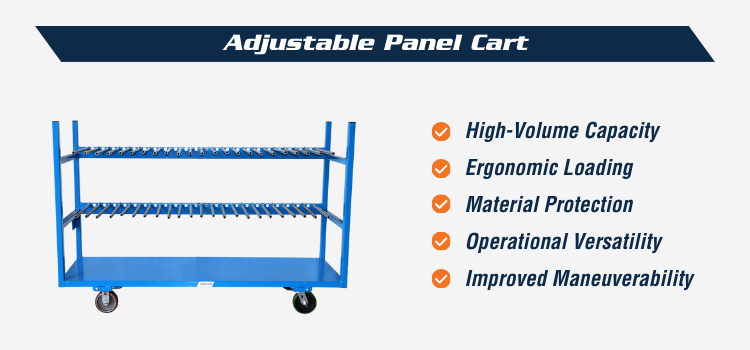
The Adjustable Panel Cart (APC) from BHS provides a much more robust solution for industrial sheet handling than a standard dolly. By holding panels in vertical rows, the APC improves both throughput and safety through the following features:
- High-Volume Capacity: With a 1,000-pound load rating and multiple dividers, APCs move bulk orders in a single trip that would require dozens of trips with a single-sheet dolly.
- Ergonomic Loading: Vertical orientation allows for one-person loading at an optimal height, eliminating the awkward postures and heavy lifting associated with horizontal flatbeds or unstable dollies.
- Material Protection: Unlike open-base dollies, BHS carts feature PVC-coated dividers and a carpeted deck to prevent the scratching, denting, and corner damage of fragile materials.
- Operational Versatility: Removable dividers allow the fleet to be reconfigured on the fly to support varying material types, including doors, lumber, and architectural panels.
- Improved Maneuverability: Heavy-duty phenolic casters and integrated push-bars allow a single employee to steer heavy loads safely through tight warehouse aisles without needing a second spotter to balance the material.
Choosing the right equipment is essential for protecting both your workforce and your inventory. While a panel dolly might work for occasional, lightweight tasks, a dedicated panel cart ensures consistent productivity in high-volume environments.
Custom features are available on request — so whether you’re trying to find a cart with a low footprint, a high capacity, or a design that accommodates specific types of materials, we can help you find a solution. To learn more, contact our sales team at 1.800.BHS.9500.
