We use cookies to make your experience better. To comply with the new e-Privacy directive, we need to ask for your consent to set the cookies. Learn more.

Forklift Charging Station Requirements and Best Practices
June 26, 2025
|
Categories: Blogs, Manufacturing, OSHA, Material Handling, Batteries, Chargers, Efficiency, Management, Safety
Electric forklifts are essential equipment for many warehouses — and if forklifts are mission-critical equipment, so are the chargers that keep them running.
Larger operations need battery rooms to keep lift trucks running, while smaller businesses might get by with a park-and-charge setup. In either case, forklift charging stations need to be precise, efficient, and safe; otherwise, businesses can expect to pay much more in the long term.
Given that the cost of a lead-acid forklift battery ranges from $2,000-6,000, you don’t want to replace them early due to mismanagement. You also need to keep your trucks on the floor when they’re needed, and you’ll usually need to optimize floorspace. Last but certainly not least, all charging equipment must function in a way that’s safe and OSHA-compliant.
In this article, we’ll provide tips for balancing those priorities, along with a checklist for outfitting a new charging area. For additional assistance with battery room planning, call 1.800.247.9500 to speak with a member of our team.
OSHA Requirements for Forklift Battery Charging Stations
Before diving into the best practices, let’s review the Occupational Safety and Health Administration (OSHA) standards for forklift charging areas. Several requirements are relevant here, and they’re mostly within the OSHA standard for Powered Industrial Trucks (1910.178):
- 1910.178(g)(1) - Battery charging installations shall be located in areas designated for that purpose. In other words, you should have a dedicated battery room.
- 1910.178(g)(2) - Facilities shall be provided for flushing and neutralizing spilled electrolyte, for fire protection, for protecting charging apparatus from damage by trucks, and for adequate ventilation for dispersal of fumes from gassing batteries.
- 1910.178(g)(4) - A conveyor, overhead hoist, or equivalent material handling equipment shall be provided for handling batteries.
- 1910.178(g)(7) - When charging batteries, acid shall be poured into water; water shall not be poured into acid.
Your operation’s battery charging areas must be clearly defined, well ventilated, and equipped with appropriate equipment. This includes gantry cranes, battery extractors, or other equipment capable of handling batteries, along with chargers secured on heavy-duty charger stands.
Additionally, if battery watering and washing will be performed in the charging area, you should supply your employees with the tools they need to handle these tasks safely. That includes personal protective equipment (PPE) and emergency eyewash stations and showers.

Learn more: Eye Wash Stations: Requirements for Forklift Battery Rooms.
Forklift Charging Stations: Essential Equipment
Taking those OSHA standards into consideration, a safe, compliant battery room must have the following:
- Appropriately rated chargers.
- Secure charging stands.
- Cable management solutions to prevent charger cables from creating trip-and-fall hazards.
- Adequate ventilation.
- Battery extractors, gantry cranes, battery lifting beams, and other battery handling equipment.
- Level, acid-resistant flooring.
- Eyewash and emergency shower stations.
Of course, when you’re outfitting a warehouse, storage facility, or other commercial operation, your goal isn’t bare minimum compliance — you want your battery room to operate as efficiently as possible, regardless of whether you have one forklift or a full fleet.
Battery Charging Stands: Modularity and Flexibility
Choose charging stands that provide maintenance access to the charging equipment while keeping chargers elevated (and out of forklift travel paths). Stands will be exposed to battery acid over time, so they must be built for the purpose: They should be made with high-quality steel and anchored securely to the floor.
- Measure before you buy. Ensure that battery and charger stands are compatible with the size, weight, and mounting configuration of your equipment. BHS products are built to accommodate standard form factors and can be customized on request.
- Anticipate future needs. Consider modular options that can be adapted as your fleet grows.
- Where possible, optimize vertical space. In multi-tiered systems, chargers are incorporated directly into the stack, which provides an optimal footprint. Learn more: Optimizing Vertical Space in the Forklift Battery Room.

Products to Consider
BHS carries a range of Charger Stands and heavy-duty System Stands to help operations of all sizes manage change-outs safely and efficiently.
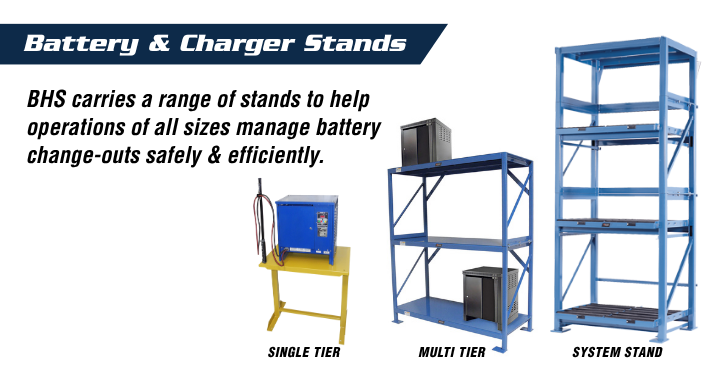
Single Tier Charger Stands are built to withstand the demands of a busy battery room in a smaller facility. Constructed from durable steel, they can support up to 800 pounds (up to 1,200 pounds for the CS-72 model), ensuring stability and longevity.
BHS Multi-Tier Charger Stands (CS-MULTI) are ideal for operations that need to optimize storage. The CS-MULTI allows you to stack chargers vertically, effectively increasing your charging capacity without expanding your footprint.
For operations with Operator Aboard Battery Extractors and Battery Carriage Systems, BHS System Stands provide safe storage with fast changeouts thanks to poly-roller battery beds. Integrated charger stands make the charging process hassle-free, and spark-proof rollers extend product life while reducing maintenance costs.
Battery Room Cable Management
According to OSHA, slips, trips, and falls are the second-most common cause of workplace injuries — and a crowded, unorganized battery room is a major liability. Cable management solutions keep cords off of the floor while also simplifying the charging process for employees.
Products to Consider
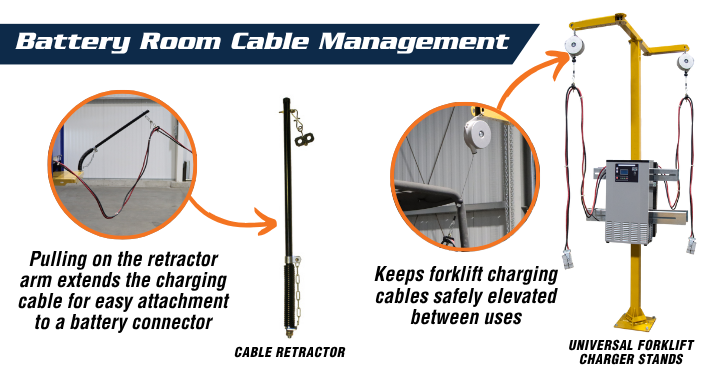
The Cable Retractor (CR-1) is a dedicated cable management tool that improves safety and productivity in the forklift battery room. Between uses, a secure clamp holds cables high above aisles to protect staff and equipment. Pulling on the retractor arm extends the charging cable. When charging is complete, simply detach the cable, and a heavy duty spring provides smooth, automatic cable retraction.
For operations with wall-mounted chargers, BHS offers the Universal Forklift Charger Stand (CSU). This versatile stand allows you to mount chargers either back-to-back or side-by-side, giving you the flexibility to configure your charging setup according to your specific needs and space constraints.
For those who need to integrate wall-mounted chargers into existing racking systems, the Vertical Charger Mount (VCM) is a great option. This mount securely attaches to a charger stand or racking, allowing you to position chargers strategically throughout your facility.
Battery Room Ventilation: Not an Afterthought
Ventilation is a concern, particularly for battery rooms with larger fleets. Lead-acid forklift batteries tend to create a lot of hydrogen and oxygen at above an 80 percent charge, which pools at the top of any enclosed space (in this case, the ceiling of your battery room).
Hydrogen pockets can be dangerous — the gas is flammable at a concentration of just 4 percent by volume, and commercial operations should limit hydrogen concentrations to a safe concentration of 1 percent.
Products to Consider
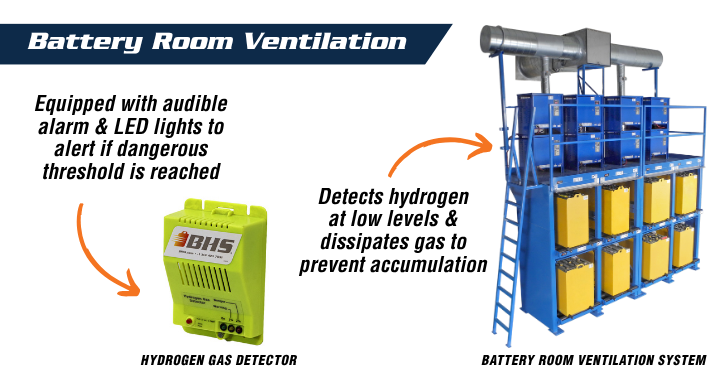
The BHS Hydrogen Gas Detector features an 80-decibel alarm to alert personnel if hydrogen reaches a dangerous threshold.
Larger operations should also invest in a ventilation system that automatically activates when the threshold is reached. The BHS Battery Room Ventilation System is an excellent solution, operating exhaust fans to bring gases down to safe levels.
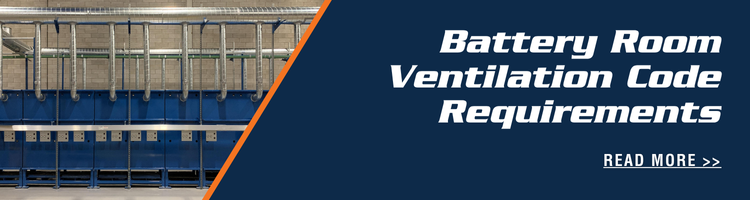
To learn more about ventilation, read: Battery Room Ventilation Code Requirements.
A Quick Checklist for Forklift Charging Station Outfitting
Here’s a checklist of best practices to keep in mind during outfitting:
- Battery charging stations are located in an area with sufficient ventilation.
- The battery charging area has appropriate plumbing to support watering, washing, and emergency shower systems.
- Battery charging areas are well-stocked with appropriate PPE.
- A sufficient number of chargers are available to support the fleet.
- Additional chargers can be added to support fleet expansion.
- Chargers are supported with stands specifically intended for that purpose.
- Cable management solutions are in place to prevent trip-and-fall hazards.
- Battery rooms with Operator Aboard Battery Extractors are outfitted with level flooring.
- For park-and-charge operations, the lead length from the battery to the charger will not exceed the manufacturer’s recommendations.
- Battery racks, charger stands, and flooring are made with acid-resistant materials.
- The battery room has appropriate signage (including “No Smoking" signs) prominently displayed.
- The battery room has a sufficient supply of warning devices including hydrogen gas detectors.
This is not a comprehensive list of considerations. Your battery room should be designed to accommodate local code requirements, the layout of your property, the size of your fleet, and the travel paths of the lift trucks.
Our sales team can help you outfit your battery room intelligently to maximize efficiency. From basic charger stands to Operator Aboard Battery Extractors, we work closely with clients to create optimal charging areas that meet the needs of each fleet — and keep lift trucks on the floor.
Contact our sales team at 1.800.BHS.9500 to learn more.
