We use cookies to make your experience better. To comply with the new e-Privacy directive, we need to ask for your consent to set the cookies. Learn more.

Steering for Your Tugger Cart System: 3 Types of Industrial Trailers
November 5, 2025
|
Categories: Blogs, Ergonomics, Manufacturing, Material Handling, Efficiency, Logistics
Material handling can account for over half of manufacturing costs. It’s safe to say that warehouses and manufacturing facilities succeed or fail by the strength of their material handling systems.
Luckily, you’ve got options, and tugger trains are among the best, especially for mission-critical jobs like line-feeding. That’s never been truer than it is today, now that AI and big-data analytics allow us to optimize our routes.
One study found that digitally optimized milk-runs — that is, delivering materials along a standard route on a set schedule, as opposed to ad hoc line-feeding — reduced cart travel by nearly a quarter while cutting costs by 18 percent.
Another study makes the value of today’s tugger trains even more starkly clear: Adding a second tugger train on a timed loop cut wait-time at the assembly point to zero while optimizing utilization rates to account for peak swells.
Of course, this sort of optimization depends on more than smart analytics. It requires the right Tugger Cart System, too. Depending on the layout of your facility and the exact route your tugger trains need to travel, “the right cart” could vary considerably — but it always depends on the cart’s steering mechanism.
Here’s a quick guide to the three major types of Tugger Cart steering systems, along with some guidance about which one is best for your use case.
3 Types of Industrial Trailer Steering Systems
It goes without saying that Tugger Carts should match your materials in terms of size, shape, and capacity. They’ll also need broadly compatible tow arms and hitches. Beyond these specifications, however, the most important feature to look for is the cart’s steering mechanism.
These are your options:
Dual Steer Tugger Carts
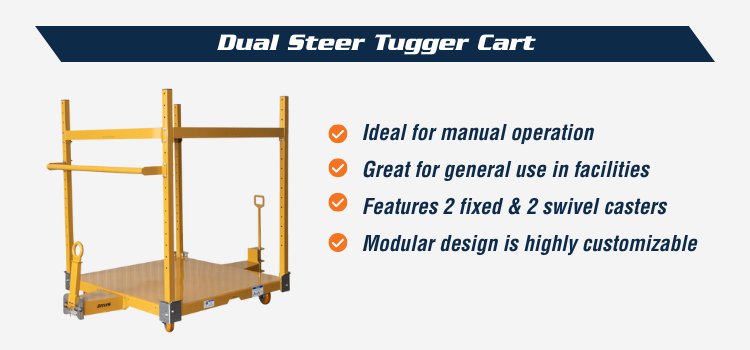
A dual steer mechanism consists of four casters: two fixed forward, and two that swivel. This arrangement provides an even balance between stable tracking and maneuverability. The fixed casters in the back keep carts moving straight without wobbles, while the swivel casters in front react to steering for efficient movement.
Benefits and Limitations
Dual Steer Tugger Carts tend to be the most common — and most cost-effective — design for industrial trailers. If you’re not sure what you need, Dual Steer models tend to be great generalists.
However, these models don’t quite turn on a dime when attached to an electric tugger. Without manual guidance, they require a little more room to move around corners than other designs
Top Use Cases
Dual Steer Tugger Carts are the easiest to push manually. If you need industrial trailers that double as manual-operated carts, this is a good choice. When built into tugger trains, however, they work best in facilities with relatively wide aisles.
Learn more about Dual Steer Tugger Carts from BHS, Inc.
Center Steer Tugger Carts
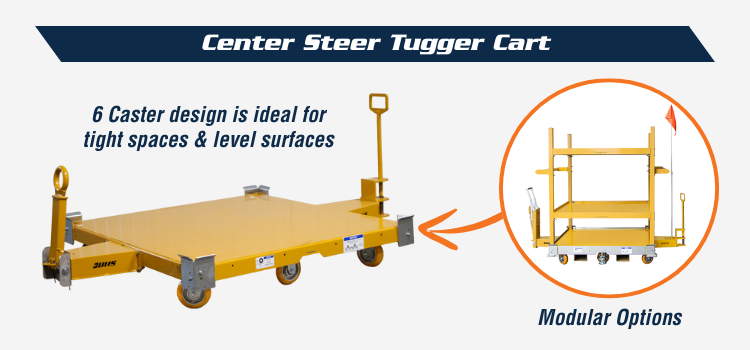
Center Steer Tugger Carts add a pair of rigid wheels to the center of the base, along with the four swivel casters at the corners. This arrangement provides a very tight turning radius, while the extra casters at the center keep movement stable and straight.
Benefits and Limitations
Of the three types of steering systems, this is the midpoint in terms of performance and price. The center steer mechanism accounts for tight turns while providing steady tracking. These carts are particularly easy to steer by hand, making them good for double-duty as both manual carts and part of a tugger train.
However, these casters work best on flat, level surfaces, and Center Steer carts tend to cost a little more than Dual Steer alternatives.
Top Use Cases
Center Steer Tugger Carts do quite well in narrow aisles, so they’re suitable for high-density warehousing spaces — as long as the floors are flat. These carts are good for both manual and tugger-train applications in facilities with narrower aisles.
Learn more about Center Steer Tugger Carts from BHS, Inc.
Quad Steer Tugger Carts
Quad Steer Tugger Carts use a pair of axles rather than fixed or swivel casters alone. Both axles turn together, creating strong, accurate steering and tracking alike. This quad steer, axle-driven design is best for busy picking trains and milk-run routes.
Benefits and Limitations
The use of axles creates excellent trackability and responsive steering. These are carts built specifically for tugger trains, and they can handle narrow aisles with ease. However, they’re not designed for manual use.
This is your best choice if you need to travel on uneven surfaces. Quad Steer Tugger Carts provide premium performance in heavy duty tugger trains.
Top Use Cases
These are the industrial trailers you want for line-feeding with heavy components and materials. They’re designed for service in tugger trains, so they work best behind a tugger. Aisle width isn’t an issue, and neither are elevation changes. Just don’t choose them if you plan to push these carts manually, too.
Learn more about Quad Steer Tugger Carts from BHS, Inc.
We offer all three types of Tugger Carts at BHS, Inc. As an original equipment manufacturer based proudly in the American Midwest, we’re also happy to design and build custom industrial trailers to meet any specification.
We’ll work with you to build the Tugger Cart System you need to optimize material handling, and realize quick ROIs for an ongoing profitability boost. We also provide product support for the lifetime of your trailers — and our phone lines are staffed by our Missouri-based employees, not AI agents or offshored third parties.
Ready to start the conversation? Contact us at 1.800.BHS.9500 to discuss your next Tugger Cart System and more.
