We use cookies to make your experience better. To comply with the new e-Privacy directive, we need to ask for your consent to set the cookies. Learn more.

Understanding Warehouse Honeycombing: Storage Solutions for Dynamic Inventory
July 22, 2025
|
Categories: Blogs, OSHA, Material Handling, Efficiency, Industry Knowledge Base, Logistics, Management, Safety
Warehouse operations can unknowingly lose a significant portion of their designed storage capacity, sometimes as much as 16% to 30%, to honeycombing.
It’s a pervasive issue in which inefficiently utilized storage space creates voids that resemble the cells of a natural honeycomb (hence the name). The problem isn’t just that your operation has a few empty pallet spots: It signifies systemic underutilization.
That’s a costly problem that can be exacerbated by dynamic inventory fluctuations. Put simply, honeycombing surrenders warehouse space — and that leads to various other operational inefficiencies.
In this blog, we’ll explain how warehouse honeycombing occurs and explore effective storage solutions and strategies to reclaim valuable space.
What is Warehouse Honeycombing and Why Should You Care?
Warehouse honeycombing means that pallet locations are partially empty, but cannot be used for other SKUs. It can also occur when entire sections of storage space are reserved for specific products that aren't currently in stock in sufficient quantities.
It isn't just an aesthetic issue — it triggers a cascade of operational inefficiencies. The most direct impact is a stark reduction in effective storage capacity: Usable storage areas shrink, so your warehouse might push towards an excessive utilization threshold much faster than anticipated.
This underutilization creates a cascade of operational inefficiencies that directly impact profitability:
- Inflated Operational Costs: Honeycombing leads to wasted labor from excess travel and double handling of goods, squandered energy on heating or cooling empty space, and an overall higher storage cost per unit.
- Reduced Productivity: Overall productivity dips as staff navigate disorganized and congested areas, which slows down critical picking and putaway operations.
- Compromised Safety: Congestion and the need for complex maneuvers to access items increase the risk of accidents, while the disorganization can lead to a higher rate of product damage and inventory errors.
Honeycombing logistics is the practice of mitigating these effects. It’s especially important with the rise of dynamic inventories.
Strategic Approaches to Combat Honeycombing
Modern warehouses grapple with constantly fluctuating stock levels, a high rate of SKU turnover, seasonal demand shifts, and frequent new product introductions. In dynamic environments, stable space planning is exceptionally difficult — but not impossible.
Traditional storage strategies aren’t as effective when inventory volumes don’t match with the allocated space. For example, dedicating lanes to single SKUs works when your SKUs are limited; when your warehouse is dynamic, restricting your lanes will lead to more partially filled pallets and underutilized locations. That directly fuels the honeycombing effect.
Instead, strategies should revolve around smarter inventory management and optimized layouts:
- Implement Intelligent Inventory Management: A robust Warehouse Management System (WMS) is foundational. It provides the real-time visibility needed for dynamic slotting — adjusting inventory locations based on current data like SKU velocity and demand patterns — to ensure products are always in the most efficient spots.
- Optimize the Physical Layout and Flow: A well-designed layout must ensure efficient material flow from receiving to shipping. That means minimizing travel distances, reducing congestion, maximizing vertical storage, and designing flexible slotting infrastructure that can adapt to changing inventory profiles.
- Adopt Proactive Inventory Handling Practices: Regularly perform inventory consolidation to combine partially filled pallets of the same SKU. Enforce disciplined inventory rotation methods like FIFO (First-In, First-Out) to prevent stock from becoming stagnant and unnecessarily occupying prime locations.
The choice of storage systems is critical in the fight against honeycombing in warehouse settings. The key is to balance density, selectivity, and cost; your warehouse logistics partner can help you choose storage systems that are aligned with your goals.
Related: Warehouse Picking Systems: 6 Strategies and the Tools That Support Them
BHS Solutions for Minimizing Honeycombing
At BHS, we understand the challenges of maximizing warehouse space. Addressing honeycombing and improving efficiency requires more than just new equipment; it requires the right equipment for your unique operation. That’s largely dependent on the SKUs that are causing the inefficiencies.
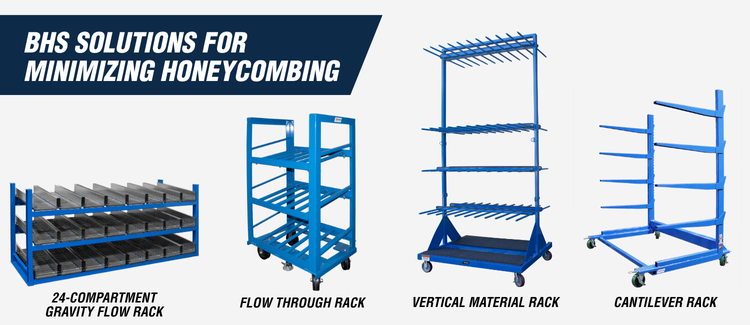
For example:
- Gravity Flow Racks are designed to promote First-In, First-Out (FIFO) movement. Gravity Flow Racks can be restocked from the rear, and the angled roller compartments smoothly move boxes or bins forward.
- Flow Through Racks (FTR) provide similar functionality with angled shelves and a portable design.
- Vertical Material Racks (VMR) simplify storage for bars, pipes, lumber, and other long, narrow materials that would otherwise cause honeycombing when stored alongside less-awkward SKUs.
- Cantilever Racks (CRA series) are configurable for handling a wide variety of awkward materials, and shelves can be adjusted in 2" (50mm) increments.
In both traditional and dynamic warehouse environments, customization is the key to improving space utilization and enhancing throughput. By tailoring racking, shelving, and material handling workflows to your exact inventory profile and processes, you can transform underutilized areas into productive assets.
The solutions team at BHS can help you create these custom systems. Contact us at 1.800.247.9500 to discuss a storage and handling solution designed to meet your facility’s specific challenges — or request a quote online.
