We use cookies to make your experience better. To comply with the new e-Privacy directive, we need to ask for your consent to set the cookies. Learn more.

The Stockroom Upstairs: Second-Floor Storage for First-Floor Retail
March 18, 2026
|
Categories: Blogs, Ergonomics, Manufacturing, Material Handling, Efficiency
Second-story stockrooms provide much more storage space than Stockrooms are an essential part of any retail space. Without them, replenishment would be a lot harder. The trouble is that stockrooms tend to take space away from sales-focused activities. Every square foot you devote to storage is one that’s not making a sale. That makes space-efficiency a central concern for stockroom design.
As we’ve learned from warehousing more generally, very often the most efficient use of space is to build vertical. If you have a second floor available in your retail space, you can make use of the same principle by locating your stockroom upstairs. There are lots of advantages to this upstairs/downstairs design, but there are also challenges.
Here’s what every retail operator needs to know about building upper-story stockrooms for first-floor showrooms, including compliance information, the advantages of this design, and what you need to succeed.
Need additional help finding the right material handling systems for your retail operation? Contact BHS, Inc. at 1.800.BHS.9500 to discuss the options.
Building Code Compliance for Combined Retail and Storage
Local building codes will vary from place to place. These will be your main source for compliance information. That said, it can help to start your research with the International Building Code (IBC), with which many local standards agree. But which set of IBC standards applies to such a mixed-use space?
The IBC rules differ depending on occupancy type — in other words, what you’ll do with the space. Retail shops are classified Mercantile, or Group M. Storage spaces like warehouses are classified as Storage, or Group S.
That doesn’t mean you have to juggle multiple occupancy types in your compliance efforts for a two-story retail-and-storage space. According to the IBC codes covering Storage Group S, a storeroom in a building in another occupancy group can be classified under that broader group. In other words, a storage space within a Group M space must comply with Group M codes first and foremost.
Of course, you might not have a space with a second floor for your stockroom. Good news: You can still benefit from upper-story storage.
Mezzanines for Second-Story Stockrooms in Retail
Don’t have a two-story building for your retail space? That doesn’t mean you can’t build a second-floor stockroom. As long as your ceilings are high enough, you can always install a mezzanine over part of the space.
A raised mezzanine floor is a (usually) free-standing structural platform that provides a second story where you install it.
The right mezzanine will allow you to make the entire first floor your retail showroom, and get all the benefits of vertical storage space. These benefits remain the same whether you have a full second-story or install a mezzanine; let’s discuss them in detail.

Learn more: What Goes On the Mezzanine Floor? Storing and Accessing “C” Stock
5 Benefits of Second-Floor Stockrooms for Retail Shops
There are plenty of advantages to locating stockrooms directly above retail shopping areas. Here are five of the most compelling. Second-floor stockrooms provide:
1. More space for direct sales activities.
In retail, space is money — so much so that the key benchmark for measuring retail success is sales per square foot. Areas of the shop devoted to sales — that is, the showroom and check-out desks — contribute directly to improving revenues. While storage areas are important, they only have an indirect effect on sales numbers.
That’s why more space for showing and selling inventory tends to lead to higher profitability. By devoting an entire first floor to sales, you can use your overall retail space as efficiently as possible. Only a second-floor stockroom makes this possible.
2. A neater showroom for a better customer experience.
Storage is essential for retail, but it doesn’t always look great. Second-floor stockrooms keep all your back-of-the-house business out of sight. That allows you to focus on great layout and overall design, key factors in overall customer experience.
In short, customer-facing areas give you more power over your customer’s experience than back-of-the house spaces — and moving your entire stockroom upstairs creates the best customer experience possible.
3. Faster access to stored inventory.
Compared to offsite storage, a second-story stockroom gives you much faster access to inventory. That leads to faster restocks, which can have a direct impact on sales. After all, out-of-stocks directly lose sales — up to 4 percent of all retail sales according to a classic study. They also reduce brand loyalty, reduce customer satisfaction, and improve the chances of customer loss to competitors, according to that same study.
the room-in-the-back model. That allows you to keep more inventory on hand, reducing the odds of an out-of-stock event. By reducing the time between an empty shelf and your restock, you can improve overall sales figures and deliver a more consistent customer experience.
4. Adaptable use of space for future growth.
When you have an entire floor devoted to storage, you’re more likely to have room to grow. You also have more space for layout changes or additional back-of-the-house duties. That flexibility positions you to respond to changes in your business, from sudden growth to whole new lines of revenue.
5. Safer material handling.
In 2023, transportation incidents were the most common source of workplace fatalities, making up nearly 37 percent of all deaths on the job. Larger on-site stockrooms reduce the number of warehouse trips delivery drivers have to make. By reducing time on the road, employers can cut down on some of the most serious occupational hazards in the retail industry.
Of course, there are also ergonomic risks associated with material handling even when you’re just moving inventory from the stockroom to the shelf. The best way to control these risks is with appropriate material handling equipment — which, in the case of a second-floor stockroom environment, means choosing the right vertical material lift.
Vertical Material Handling Between Floors or Levels
One of the greatest perceived barriers to upper-story stockrooms is the challenge of material handling. Retailers may assume they only have two options, either to install an expensive, compliance-heavy freight elevator or to ask staff to move inventory up and down stairs.
The former option is slow and expensive, while the latter is unsafe. Luckily, there’s an option that offers the perfect combination of benefits: A quick return on investment, even quicker deployment, and maximum safety benefits all at once.
A Vertical Reciprocating Conveyor (VRC) is a material handling solution designed to move stock between floors, levels, or different elevations. This vertical material handling solution is similar to a freight elevator, but it’s only designed for materials, not people.
That distinction makes VRCs much more affordable and easier to maintain than freight elevators, without sacrificing performance. They’re the ideal vertical material lift for moving stock from an upper-story stockroom or mezzanine to your ground-floor retail space.
Learn more: Vertical Reciprocating Conveyors (VRCs) Vs. Freight Elevators
At BHS, Inc., we offer two types of Vertical Reciprocating Conveyors to match any use case, including retail spaces with upper-floor stockrooms.
Hydraulic Cantilever Vertical Reciprocating Conveyors
Our line of hydraulic VRCs provide the fastest way to start moving stock from upstairs to your first-floor showroom. With up to 6,000 pounds (2,722 kilograms) of carrying capacity, and a platform with plenty of room for full pallets, these vertical material handling solutions can move plenty of freight.
Unlike most VRCs, however, our hydraulic conveyors ship assembled. That means all you have to do is secure the base and connect power, and you can start moving inventory. A compact overall footprint allows this unit to fit into most spaces without alteration, while cantilever design positions the platform to support all common loading patterns, including three-way access.
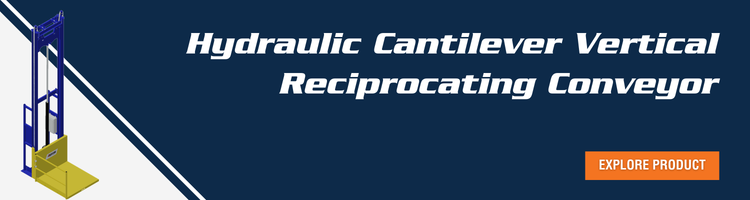
Learn more: Hydraulic Cantilever Vertical Reciprocating Conveyor
Mechanical Straddle Vertical Reciprocating Conveyors
Mechanical VRCs lift heavy loads with an electric motor, gears, and chains as opposed to hydraulic cylinders. This design provides greater travel heights (25 feet rather than the standard 15 feet for hydraulic models) and faster travel speed (28 feet per minute).
The two-post straddle design balances weight — like hydraulic VRCs, up to 6,000 pounds (2,722 kilograms) — between uprights, creating a compact footprint. The platform supports “C” and “Z” shaped loading patterns.
Learn more: Vertical Lift Traffic Patterns: Planning for VRC Material Flow
Choose Mechanical Straddle VRCs if you have a second story stockroom that’s up to 25 feet above your ground floor, or if you need fast operation for frequent restocking. Both models provide much simpler deployment than most VRCs, since they don’t require a lengthy custom planning phase.
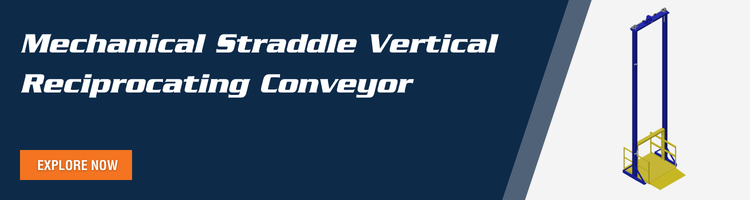
Learn more: Mechanical Straddle Vertical Reciprocating Conveyors
That said, at BHS, Inc., we also offer fully custom vertical conveyors to meet any specification. Fill out our Custom Manufacturing request form to get started, or contact our Sales Team at 1.800.BHS.9500 to discuss material handling for your second-floor stockroom today.