We use cookies to make your experience better. To comply with the new e-Privacy directive, we need to ask for your consent to set the cookies. Learn more.

What Goes On the Mezzanine Floor? Storing and Accessing “C” Stock
January 28, 2026
|
Categories: Blogs, Ergonomics, OSHA, Material Handling, Efficiency, Safety
A growing number of operations are growing up rather than out: The global market for industrial mezzanines reached approximately $8.4 billion in 2024, a number that’s expected to grow to around $11 billion by 2033.
Mezzanines offer an immediate solution to rising rents and space limitations. They can instantly double the usable square footage of a facility at minimal cost, and more stock can mean more versatility for certain types of operations.
Not every warehouse needs extensive vertical storage — but when you need mezzanines, you need a thought-out material handling strategy to make the most of your investment. Efficient warehouses pair a comprehensive ABC analysis with the right vertical material handling equipment (MHE).
Here’s what you need to know about optimizing your mezzanine for "C" stock and selecting the right equipment to keep your operation flowing.
Warehouse Inventory Management and Vertical Storage
Before we discuss material handling, let’s break down some of the basics of warehouse inventory management. The golden rule is pretty basic: Keep your most active (and therefore most valuable) inventory in your most accessible locations.
In a standard facility, the prime real estate is the ground floor zone nearest to your shipping and receiving docks. Storing inventory in this area minimizes travel time for forklifts and pickers, which directly increases throughput.
Mezzanines, by definition, are secondary real estate. They require vertical travel, which introduces a time cost. To maximize efficiency, you must populate your mezzanine with items that can tolerate a delay in access without disrupting your core fulfillment velocity. This is where an accurate ABC analysis comes into play.
Defining Your Inventory: ABC Analysis
ABC Analysis is an inventory categorization technique based on the Pareto principle. That principle is sometimes called the 80/20 rule: It holds that 80% of outcomes come from 20% of causes.
When applied to warehousing, this means approximately 20% of your SKUs will drive about 80% of your annual consumption value. To optimize your storage strategy, divide your stock into three categories based on that value (Quantity Consumed × Unit Cost):
- A Stock (High Consumption Value): These are your critical revenue drivers. While they represent a small percentage of your total SKUs (approx. 20%), they account for the vast majority of inventory value. They require strict control and immediate, ground-level access.
- B Stock (Moderate Consumption Value): These serve as the middle ground — items with steady demand that don't quite match the turnover rate or value of your ‘A’ items, but still require regular access.
- C Stock (Low Consumption Value): This category typically makes up the bulk of your physical inventory count (often 50% or more) but accounts for the smallest portion of consumption value (perhaps 5%).
While "C" stock is technically defined by financial value, it frequently correlates with low velocity. "C" items are often slow movers, spare parts, seasonal items, or bulk overstock.
If you’re building vertically, your goal is to keep that “C" stock as accessible as possible to minimize the secondary costs associated with an order (primarily picking time). That’s where material handling equipment comes into play
Why Does “C” Stock Belong on the Mezzanine?
Because ‘C’ items are accessed less frequently, the additional time required to transport them from a second level has a smaller impact on your overall operational speed. Moving these slow movers to the mezzanine clears your valuable ground-floor space for high-velocity ‘A’ stock, allowing your pickers to fulfill the majority of daily orders with minimal travel.
However, designating the mezzanine for ‘C’ stock comes with an operational challenge: weight and bulk. While ‘C’ items may be low in value, they are often high in volume — think bulk supplies, packaging materials, or heavy spare parts. Moving these materials up and down a staircase is dangerous and inefficient.
Why Not Use Forklifts for Mezzanined SKUs?
Before investing in dedicated infrastructure, many operations attempt to service their mezzanines using existing equipment — lift trucks. And forklifts are quite effective in some facilities, provided that the SKUs in question are low-turnover.
But utilizing a forklift ties up a valuable piece of equipment and a certified operator. In most operations, that’s a heavy cost; there are simply better jobs for the forklifts to do (for example, loading and unloading trucks). Depending on your facility’s layout, unnecessary lift truck traffic could also create significant operational bottlenecks.
There’s another problem to consider: lifting heavy loads to a second level with a forklift requires extreme precision. Pallets could fall from the mezzanine edge, which could lead to a serious accident. Simple mezzanine hoists (winch-and-cable systems) are another option, but they’re slow, and their weight capacities are limited.
Using Vertical Reciprocating Conveyors (VRCs) for Mezzanines
To bridge the gap between the ground floor and the mezzanine effectively, consider Vertical Reciprocating Conveyors (VRCs).
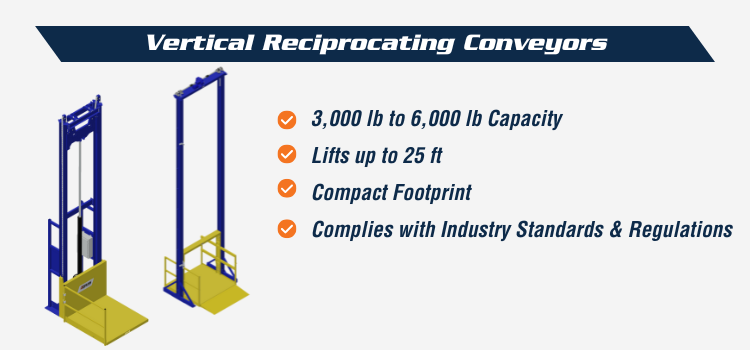
A VRC is a specialized freight lift designed exclusively to move materials — never people — between facility levels. Because they are not intended for human transport, they are governed by the ASME B20.1 safety standard for conveyors rather than the stricter elevator codes (ASME A17.1). VRCs are significantly less expensive to install, operate, and maintain than freight elevators, while still providing a robust solution for moving heavy pallets and carts.
By installing a VRC, you create a dedicated artery for your ‘C’ stock. You can bulk-load the lift with pallets of slow-moving inventory, send it to the mezzanine, and offload it without a forklift operator ever leaving the ground floor.
That approach separates material traffic from foot traffic and ensures that your forklifts stay focused on high-speed tasks.
3 VRC Features to Look For
When selecting a VRC to handle your mezzanine inventory, you are investing in a critical piece of industrial infrastructure. To ensure you choose a system that is safe, compliant, and durable, look for the following features:
Feature #1: Compliance and Safety Engineering
By nature, VRCs support a safer warehouse — after all, you’re installing a dedicated piece of equipment to handle the lifting, and that equipment will not transport human workers. Even so, the safety features of individual VRCs can vary.
Ensure that the VRC is engineered to meet or exceed ASME B20.1 standards. A robust system should include emergency drop locks that automatically engage to prevent the carriage from falling if the lift system fails. Look for velocity fuses that stop uncontrolled descent in hydraulic systems, and interlocks that prevent the lift from moving unless the gates are securely closed.
Feature #2: The Right Lift Mechanism
VRCs are generally divided into two categories: hydraulic and mechanical. Your choice depends on your specific duty cycles and height requirements.
- Hydraulic VRCs: These use a pump and cylinder system to lift the carriage. They are cost-effective, operate quietly, and are ideal for standard two-level applications like mezzanines (typically up to 30 feet).
- Mechanical VRCs: These use a powerful motor and roller chain or cable system. They are the superior choice for high-speed, continuous-duty cycles or multi-story applications.
Once again, there’s no “right" choice. Gather some basic info about your mezzanine stock (such as average weight, access frequency, and so on), then discuss options with your MHE partner.
Feature #3: Optimized Traffic Patterns
The physical design of the VRC frame determines how you can load and unload it. You should choose a traffic pattern that matches your facility's flow.
- Z-Pattern: Loading from the front and unloading from the back (opposite sides). This is ideal for straddle designs where you want a straight-through flow.
- C-Pattern: Loading and unloading from the same side. This mimics a traditional elevator and works well for retrofits.
- 90-Degree (L-Pattern): Loading from the front and unloading from the side. This requires a cantilever or four-post design.
To learn more about VRC traffic patterns, read: Vertical Lift Traffic Patterns: Planning for VRC Material Flow.
Products from BHS, Inc.
At BHS, we engineer VRCs to fit seamlessly into your existing workflow, ensuring that your vertical warehouse strategy meets your business objectives.
Hydraulic Cantilever Vertical Reciprocating Conveyor (VRC-HC)
The ideal workhorse for standard warehouse mezzanines, the VRC-HC ships pre-assembled for easier installation and handles loads up to 6,000 pounds. Its cantilever design offers a compact footprint, allowing for flexible 3-way loading (front, left, or right) to suit tight spaces.
Three carriage options are available for common materials, and travel speeds of up to 21 feet (6.4 meters) per minute support high-throughput operations.
Mechanical Straddle Vertical Reciprocating Conveyor (VRC-MS)
Designed for high-throughput environments, the VRC-MS offers faster travel speeds of up to 28 feet (8.5 meters) per minute. Its straddle design distributes weight evenly, making it exceptionally stable for heavy loads and large platforms up to 90" x 96".
The VRC-MS is an appropriate option for 25 feet (7.62 meters) of vertical travel, more than enough for most mezzanines. It’s perfect for continuous-duty cycles where speed and power are the top priorities.
Safety features for both units include mechanical interlocks, position sensors, and additional proximity sensors to prevent gaps between loading areas and carriages. Custom carriages and units are available on request.
Ready to outfit your operation?
Optimizing your mezzanine with the right "C" stock strategy is only possible if you have the right equipment to move it. Contact the BHS sales team at 1.800.BHS.9500 or request a quote online to start designing your vertical reciprocating conveyor system today.