We use cookies to make your experience better. To comply with the new e-Privacy directive, we need to ask for your consent to set the cookies. Learn more.

Managing Material Flow: Box Dumpers, Tote Dumpers, and Gaylord Dumpers
August 20, 2025
|
Categories: Blogs, Ergonomics, Manufacturing, Material Handling, Efficiency, Safety
In a manufacturing context, material flow refers to the entire process of item movement — from raw materials to finished goods. It’s a simple concept to explain, but incredibly difficult to optimize: Issues with material handling can lead to bloated inventory costs, excessive waste, and in some cases, more severe consequences like production stoppages and high employee turnover.
When you’re tackling material flow optimization, bin dumpers (which are also called bin tippers, box dumpers, Gaylord dumpers, and about a dozen other names) can play a major role. But if your goal is to automate infeeds, you need to find the exact tool for the job.
In today’s article, we’ll explore how different types of bin dumpers can complement a well-planned material flow strategy. First, an important note: All material handling equipment works best when it’s designed for the task at hand.
BHS works closely with suppliers, manufacturers, and warehouse operators to create custom solutions — and we take a personal interest in our customers' success. Whether you need to meet compliance requirements, work with unconventional materials, or minimize your footprint, we’re ready to help. To get started, call 1.800.BHS.9500, request a quote online, or learn more about custom manufacturing & material handling integration.
Material Flow Optimization: How Manual Feeds Cause Problems
At its core, material flow includes every stage of the product (or the value stream). That encompasses:
- Procurement of raw materials.
- Internal transport between work cells.
- Production processes.
- Storage.
- Order picking.
- Final distribution.
As virtually every manufacturer learns on day one, the initial infeed stage is a critical point of vulnerability. This is where bulk materials are introduced into a process — and while you can use manual labor for infeeding, that’s less than ideal.
Why? For starters, manual lifting tends to cause injuries and overexertion, both of which are bad for business:
- Higher Injury Rates: The transportation and warehousing sector reports an injury and illness rate of 4.5 cases per 100 full-time workers, substantially higher than the private industry average.
- Significant Downtime: Overexertion, a hallmark of manual lifting, is a leading cause of injuries that result in Days Away From Work (DAFW). The median number of lost workdays for such an injury is 14. Needless to say, sidelining a key employee for nearly three weeks isn’t great practice.
- Substantial Direct Costs: The National Safety Council (NSC) reports that the average direct cost per medically consulted injury has reached $41,000. This doesn’t include the extensive indirect costs of lost productivity, overtime for other workers, and hiring temporary replacements.
But more practically, manual labor is inconsistent, slow, and difficult to control in any meaningful way. Box dumpers are the solution: They automate the lifting and emptying of bulk containers, eliminating ergonomic risks. They provide consistency, which lets you focus on other aspects of material flow outside of the infeed stage.
Perhaps most importantly, they automate a task that nobody really wants to do — helping you attract workers and keep them on the floor.
Using Box, Tote, and Gaylord Dumpers to Automate Infeeding
The industrial dumper is an extension of the standard bin tipper, which has been a popular waste handling solution for years. At BHS, we’ve advocated for bin dumpers for years, citing their obvious ergonomic benefits — and we’ve found that they have dozens of applications outside of waste management streams.
The most practical way to classify this equipment is by the type of container it handles (which lets you easily align the equipment precisely with your operational needs). The three primary categories are Box Dumpers, Tote Dumpers, and Gaylord Dumpers.
Box Dumpers
Box Dumpers are the solution for operations that process materials in cardboard containers or corrugated cartons. Their primary role is to provide a controlled, automated method for introducing smaller items into a workflow, such as feeding components to an assembly line.
One example of this is a case study about a manufacturer of utility and OEM components that struggled with efficiency and ergonomics on the production line. Box dumpers were designed to improve worker comfort and to fit seamlessly into a conveyor system. This common scenario highlights the value of implementing material handling interventions that result in a safer, more consistent process.
Tote Dumpers
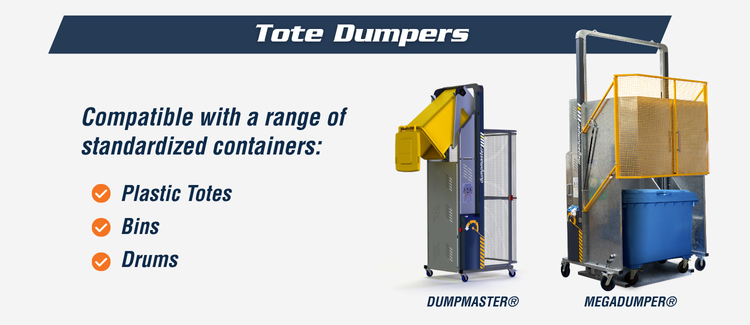
This is a versatile and broad category of Bin Dumpers designed to manage a wide array of standardized industrial containers, including plastic totes, bins, and drums. The Multi-Tip® can also be utilized as a tote dumper.
For heavy-industrial applications, the Dumpmaster® Hydraulic Bin Dumper offers a standard capacity of over 660 pounds and a variety of standard tipping heights. The Dockmaster is designed to invert bins as low to the ground as possible — just 27.5 inches (700 millimeters) — while still keeping the weight within the footprint of the machine.
For ultra-heavy duty loads, the MegaDumper® Hydraulic Bin Dumper can handle up to 1,323 pounds (600 kilograms) and can be customized to tip almost any container at heights from 47 inches (1184 mm) to beyond 33 feet (10 m).
Gaylord Dumpers
To explain Gaylord Dumpers, we must first define Gaylord container as a term. A Gaylord container is a pallet-sized bulk box also known as a pallet box or octabin. A Gaylord box (named for the bulk packaging solutions originally designed by the Gaylord Container Company) is usually made of corrugated material. Whether it's double-wall corrugated or triple-wall corrugated cardboard, these shipping containers can be made from recycled materials, making them an affordable and sustainable favorite for bulk shipping.
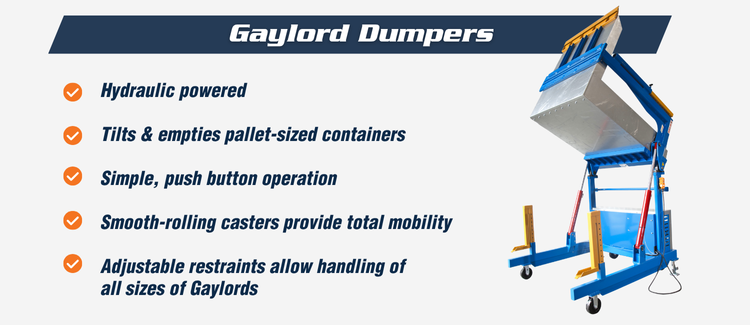
Gaylord Dumpers are heavy-duty machines specifically built to handle these bulk containers. This equipment is indispensable for operations that process corrugated boxes full of materials such as metals, granular chemicals, or recyclables.
Due to the significant weight and size of these containers, Gaylord Dumpers are characterized by their robust steel construction and high load capacities. They're common solutions in material supply chains, food processing facilities, and bulk cargo handling in general.
Advanced Material Flow: The BHS Lifting Gaylord Dumper
Materials frequently need to be fed into tall hoppers, elevated sorting systems, or large-scale mixers where the receiving point is several feet off the ground. All of these scenarios demand a machine that can first lift a heavy container vertically and then execute a controlled dump.
The BHS Lifting Gaylord Dumper (GLD-L) is engineered precisely for these demanding, multi-stage applications. It combines heavy-duty lifting power with the functionality of a high-angle dumper, all within a mobile and flexible platform.
The benefits of integrating a BHS Lifting Gaylord Dumper into your material flow include:
- Dual-Functionality and High Capacity: The GLD-L can elevate a fully loaded Gaylord to a tip height of 5'-12' before tilting it and dropping the contents. It is available in 2,500-pound capacity models to handle serious industrial loads.
- Durable Construction and Safe Operation: The GLD-L is built for longevity in harsh environments. Its heavy-duty, all-steel construction is protected by an impact- and chemical-resistant powder-coat finish. Operation is managed through a simple push-button remote pendant, which allows the operator to stand at a safe distance from the machine during the lift and dump cycle.
The mobility of the BHS Lifting Gaylord Dumper makes it a true asset for manufacturers. Traditional, fixed material handling infrastructure can hinder flexibility; the GLD-L enables rapid changes in layout and workflow without costly infrastructure modifications.
A Facility Manager’s Guide to Selecting the Right Dumper
Choosing the correct dumper is a critical decision. Here are some considerations to keep in mind when purchasing:
1. Container Analysis: What Are You Dumping?
The first step is to precisely define the unit of load.
- Container Type: Identify the primary containers used for infeed: cardboard boxes, plastic totes, 55-gallon drums, or Gaylord containers.
- Dimensions: Accurately measure the length, width, and height of your most common containers.
- Weight: Determine the maximum weight of a fully loaded container and design for the heaviest possible load to ensure a sufficient safety margin.
2. Application Requirements: Where and How Are You Dumping?
Next, define the practical operational parameters of the task. If you’re not sure how to measure something like cycle frequency, contact BHS to speak with an engineer.
- Dump Height: Measure the required tip height needed to clear the lip of the receiving equipment (hopper, conveyor, vat).
- Cycle Frequency: Determine how many dumps are required per hour or per shift to keep pace with production.
- Functionality: Decide if the application requires a simple tip-at-ground-level action or a more complex "lift, then dump" motion.
3. Facility and Power Constraints: What Is Your Operating Environment?
The dumper must integrate seamlessly into your existing infrastructure.
- Footprint: Measure the available floor space for the equipment, considering both its static footprint and the operational area required for the full dumping arc.
- Mobility: Decide whether the dumper will be a permanent part of a fixed production line (stationary unit) or if it needs to serve multiple locations (mobile unit).
- Power Availability: Identify the available power sources in the intended operating area (e.g., single-phase or three-phase electric).
Of course, every facility has unique challenges — and your MHE partner should be able to support your operation as you develop a strategy for improving your material flow.
With a long history of developing standard and custom-engineered solutions, the BHS team can analyze your specific workflow, identify key points of risk, and provide a tailored equipment solution that delivers maximum value.
For a comprehensive consultation on your material handling needs, contact the BHS sales team at 1.800.BHS.9500 to find a dealer near you.
