We use cookies to make your experience better. To comply with the new e-Privacy directive, we need to ask for your consent to set the cookies. Learn more.

Choosing a Forklift Barrier: Wheel Stops, Rails, or Bollards?
December 3, 2025
|
Categories: Blogs, Manufacturing, Material Handling, Efficiency, Management
In 2013, U.S. workplaces were home to almost 7,000 forklift-related injuries serious enough to require days off work. While the number of yearly injuries went up and down over the following decade, in 2022, the last year for which we have data, nearly 8,000 people were hurt by forklifts on the job.
What can we do to finally bring these statistics down? According to the NIOSH Hierarchy of Controls, the best options would be to remove or replace forklifts entirely. That’s not possible in most cases, which leads to the third-strongest item on the NIOSH Hierarchy of Controls: Engineering Controls, or isolating people from the hazard.
Sometimes that means keeping pedestrians and forklifts apart with physical barriers. Sometimes it means keeping forklift operators safe by preventing roll-offs — again, using physical barriers.
But in addition to protecting employees, warehouse operators must keep products, materials, and infrastructure safe from forklift strikes. That gives us a third reason to use physical barriers: To protect assets.
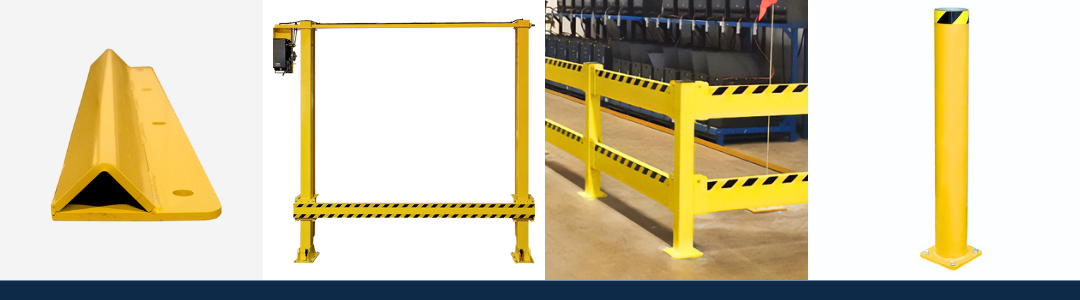
There are three general types of barriers you can rely on to stop industrial trucks: Forklift Wheel Stops, Structural Barrier Rails, and Structural Bollards. Here’s a quick guide to choosing between these options.
Top Use Cases for Forklift Barriers
Each of the three types of forklift barriers has its own particular strengths and limitations. These attributes make these barriers appropriate for different use cases. Keep reading to learn which barrier is best for which workplace scenario.
Forklift Wheel Stops
Forklift Wheel Stops are designed to block industrial trucks without creating barriers (or tripping hazards) for pedestrians. They consist of heavy-duty steel ridges, just two inches at their highest point. That’s high enough to stop a forklift, but not so high it’s hard to step over.
This combination makes Forklift Wheel Stops ideal for shared traffic spaces. They’re also good for blocking forklift movement while still providing access to forks.
Top use cases for Forklift Wheel Stops include protecting stretch wrappers and shelving units without blocking access to forks; lining aisle ends for safer turns; and creating designated forklift traffic zones that may sometimes have to accommodate pedestrian traffic.
Learn more about Forklift Wheel Stops from BHS, Inc.
Structural Barrier Rails
Structural Barrier Rails — also called guard rails or protection rails — are continuous steel fences engineered to stand up to a forklift strike. Look for rails with high-visibility paint and an impact rating of 10,000 lbs. at 4 miles per hour.
These forklift barriers may have one or two rails, depending on your need, so there are multiple height options. Either way, however, steel railing works best for permanent barriers that don’t have to let pedestrians through. They also keep forklifts from going over edges at docks or higher levels.
Top use cases for forklift guard rails include separating forklift and pedestrian traffic lanes; shielding workstations; and lining mezzanine edges.
Learn more about Structural Barrier Rails from BHS, Inc.
Structural Bollards
Structural Bollards are the simplest forklift barriers available, but that doesn’t make them any less effective than wheel stops or rails. Bollards consist of heavy steel or concrete posts, strong enough to stop an industrial truck. Be sure to choose bollards with high-visibility finishes.
Bollards allow pedestrians to easily step around, while blocking both industrial trucks and their forks. They’re usually deployed at specific points, not as full-lane guarding.
Top use cases for Structural Bollards include pedestrian protection around doorways; racking protection at ends and corners; and equipment protection.
Learn more about Structural Bollards from BHS, Inc.
Safety Barriers & Guardrails from BHS, Inc.
BHS, Inc. engineers and manufactures forklift barriers at our state-of-the-art facility in St. Louis, Missouri. As a family-owned business that’s been creating forklift infrastructure since 1978, we’re always happy to provide companies with the right equipment — even if that means building something entirely new from scratch.
We offer a full selection of Safety Barriers & Guardrails, plus custom manufacturing capabilities to solve any challenge. Our products include Forklift Wheel Stops, Structural Barrier Rails, and Structural Bollards — as well as Protective Rails, Powered Dock Gates, and Pallet Rack Protectors.
Need help planning a safe, reliable forklift barrier at your facility? Contact the experts at BHS, Inc. by calling 1.800.BHS.9500 today.
