We use cookies to make your experience better. To comply with the new e-Privacy directive, we need to ask for your consent to set the cookies. Learn more.

OSHA Propane Regulations for LP Lift Truck Fleets
December 2, 2020
|
Categories: Blogs
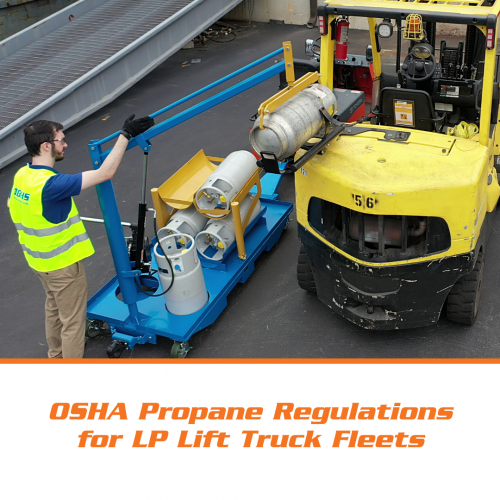
Forklift trucks that run on liquid propane (LP) can be safe additions to a warehouse fleet, but operations need to take additional precautions to maintain compliance with regulations set by the Occupational Safety and Health Administration.
The good news is that most propane regulations are straightforward. For the most part, OSHA requirements for propane are detailed in 1926.153, though other occupational safety and health standards apply to cylinder handling and storage. To maintain compliance with workplace safety standards, employers need to understand the regulations, invest in suitable equipment, and train employees to follow safe handling and storage practices.
Propane Tank Storage: OSHA Regulations and Related Tips
Liquid propane is a form of liquefied petroleum gas. Like all liquefied petroleum gases, LP can create an explosive force if fuel containers are compromised. Proper storage of compressed gas cylinders helps to mitigate the risk.
First, you must choose a safe location for LP tank storage. According to OSHA, outdoor propane tanks must be stored a certain distance away from buildings — but these distances vary based on the quantity of liquid propane you store.
For compliant OSHA propane tank storage, distance from building requirements are as follows, per Table H-23 in OSHA 1910.110(f)(6)(i)(c):
-
You can store up to 500 pounds of LP gas without distance requirements.
-
If you store between 501 and 2,500 pounds of LP, you don’t have to locate them any particular distance from your own buildings — but they do have to stay at least 10 feet away from your neighbors’ buildings or any sidewalks.
-
If you store between 2,501 and 6,000 pounds of propane, it must be 10 feet from buildings.
-
For 6,001 to 10,000 pounds of LP, storage must be located 20 feet away from buildings.
-
If you store more than 10,000 pounds of liquid propane, you must keep storage spaces at least 25 feet away from buildings.
Because propane is heavier than air, it will settle to the ground. Pockets of propane could ignite when exposed to a heat source, and storing gas cylinders in an open-air storage unit helps to prevent gases from building to dangerous concentrations.
Of course, cylinder storehouses and transporters must also provide adequate security and fire protection for products. They also need to protect cylinders from the weather. BHS offers the Cylinder Storehouse (CSH) and Cylinder Storage Cage (CSC), both of which use slotted metal to provide for safe and secure storage for portable containers of combustible materials. The Cylinder Storehouse is a safety cage with a pitched roof to minimize exposure to the elements, and its modular design allows for expansion as an operation’s fleet grows. Investments in cylinder storage pay off in the long term, as proper storage helps to keep tanks in optimal condition for regular use — and limits the possibility of a OSHA violation. (Regardless of which option you choose, as a best practice for fire protection, always ensure a fire extinguisher is accessible near the storage area.)
Other important considerations to keep in mind when choosing propane storage solutions:
-
LP lift truck propane cylinders can be stored in an upright position or in a horizontal position. However, a vertical propane tank's safety relief valves must be vented upwards within 45 degrees of the vertical, per 110(e)(7)(ii).
-
Gas containers should be stored in a location that minimizes exposure to physical damage, tampering, or excessive temperature rises, per 1910.110(f)(2)(i). That requires storehouses with firm foundations and plenty of cubic feet for ventilation. It also requires temperature control. Propane tanks leave some vapor space, which allows contents to expand in higher temperatures; but too much heat can still cause a rupture.
-
LP containers cannot be stored near exits, stairways, or in storage rooms “normally used for the safe exit of people,” per 1910.110(f)(2)(ii). Likewise, LP-powered trucks should not be left in egress areas.
Consult OSHA regulations when expanding your fleet, as the administration has strict limits for the amount of LP gas stored onsite (those limits vary depending on whether the gases are stored inside or outside of buildings, the location of nearby buildings, and other factors).
Training Staff to Handle LP Cylinders Safely
To keep fleets operating at optimal efficiency, employers should choose refueling solutions that promote proper ergonomics. While OSHA regulations don’t specifically cover ergonomics, the General Duty Clause allows inspectors to issue violations for practices that carry significant, avoidable risks — asking employees to manually lift LP gas canisters certainly qualifies. There are also practical reasons to invest in ergonomics: Dedicated propane handlers improve productivity, allowing a single employee to refuel multiple trucks quickly and safely.
The BHS Propane Tugger Trailer (PTT-6) is an ergonomic solution for handling LP tank changes. Capable of carrying six 8-gallon LP tanks, it has an integrated crane with a hand pump and release lever, so employees don’t need to bend, twist, or lift to refuel multiple lift trucks on a single run. A combination of swivel and rigid casters ensure smooth travel, improving safety for common LP cylinder handling tasks.
Any employee who works with LP tanks & cylinders should be trained to handle fuels safely. Propane gas is a safe fuel, but common-sense precautions must be taken to prevent a disaster and to maintain full compliance with OSHA.
For example:
-
Only authorized workers should replace LP containers. These workers should receive proper training and refresher training.
-
All personnel should wear gloves when handling gas canisters. Liquid propane gas is extremely cold, frostbite can occur within seconds.
-
LP lift trucks and canisters must be inspected regularly. Damaged trucks and canisters must be fully repaired before returning to use. Staff should check the manual shutoff valve, container valves, cylinder collars, the relief valve, and other elements of the tank.
-
Trucks and canisters can never be exposed to potential sources of ignition. That includes leaving LP canisters in areas prone to excessive heat, per 1910.110(e)(13)(v).
-
Never repair lift trucks near propane cylinders. Vehicles cannot be serviced within 10 feet of LP gas containers, per 1910.110(h)(6)(ii)(b).
With proper storage and handling, LP-powered lift trucks are both safe and reliable. OSHA regulations can be a valuable tool for employers, and compliance helps to ensure a safe propane handling strategy.
