We use cookies to make your experience better. To comply with the new e-Privacy directive, we need to ask for your consent to set the cookies. Learn more.

How to Prevent Construction Site Theft: 5 Tips for Securing Tools
June 25, 2025
|
Categories: Blogs, Material Handling, Construction
If you’re working with expensive tools and construction materials, theft is a threat to your business. That's why every construction firm needs a reliable tool theft prevention plan.
According to one paper from East Tennessee State University, U.S. construction companies suffer $1 billion in direct losses from theft on building sites each year. And while the direct costs are certainly considerable, the indirect costs of theft can be just as crippling: Higher insurance premiums and additional project delays can quickly add to the bill.
Standard security systems include adequate fencing, proper lighting, and video surveillance coverage with plenty of security cameras. Unfortunately, they can also fall short at the point of use within a dynamic construction job site — to limit your risk of theft, you need to protect against both internal and external theft, while also keeping tools and materials accessible.
Below, we’ll take a broad look at how construction site theft impacts businesses. We’ll also provide strategies for bridging the gap between strict security and operational efficiency.
Construction Site Theft Prevention: Setting the Scope
As every construction site manager knows, theft is a big problem. In 2021, there were over 11,500 reported instances of theft at U.S. construction sites, significantly exceeding the reported thefts at convenience stores, gas stations, or grocery stores.
According to numbers from the National Incident-Based Reporting System (NIBRS), contractors lose an average of $6,000 per incident — theft involving heavy machinery can push that number to $30,000.
The biggest targets include:
- Heavy Equipment: A large piece of machinery tends to have a high value, so heavy construction equipment is a natural target for thieves. In one study performed by LoJack, wheeled and tracked loaders (including skid steers and backhoes) account for the largest percentage of construction equipment theft (approx. 26%), followed closely by towables like generators, compressors, welders, and light towers (approx. 20%). Certain brands are disproportionately targeted, with John Deere and Kubota frequently topping the list, followed by manufacturers like Caterpillar (CAT), Bobcat, and Case. Note: Anti-theft devices like wheel locks and hitch locks can help to mitigate these risks.
- Materials: Raw building materials are highly susceptible to theft. Copper wiring and piping are perennial favorites due to high scrap value, with estimates suggesting $1 billion worth is stolen annually across various industries, a significant portion originating from construction sites. The dramatic increase in lumber prices since 2020 has made timber an increasingly attractive resource for potential thieves. Other materials commonly stolen include steel (rebar), plumbing fixtures, doors, windows, drywall, and insulation.
- Tools: Power tools have a high value relative to their size. They’re also portable, difficult to trace, and easy to resell on black markets or online platforms — so they’re ideal targets for thieves. Specific high-value items like generators, laser levels, and advanced survey equipment are often targets, but the cumulative loss from the repeated theft of smaller, less expensive tools can also lead to substantial financial losses over time (smaller tools include wrenches, hammers, drills, and 10mm sockets — well, maybe not the sockets, but they’re always missing).
- Appliances: In residential construction, particularly multi-family projects, installed or stored appliances like refrigerators, ovens, dishwashers, and water heaters are common targets.
Unfortunately, crimes at construction sites rarely end with prosecution or recovery. Overall recovery rates are exceptionally low: The East Tennessee State University study estimates recovery rates of around 7% across all types of stolen items. Clearly, it's essential to have an effective loss prevention plan.
Factors That Make Construction Sites Targets for Theft
Before we discuss prevention strategies, let’s consider why thieves target buildings under construction:
- Site Vulnerability: Construction sites are often easy targets due to open perimeters, poor lighting, and lack of on-site security staff.
- Valuable Assets: As we’ve discussed, assets on construction sites include a lot of valuable materials and difficult-to-trace construction equipment. Those types of assets are easy to sell.
- Portability of Targets: It’s particularly easy to conceal and remove tools from a site undetected.
- Opportunity for Internal Theft: Employees and subcontractors have legitimate access to the site, so they have opportunities to steal tools and materials.
- Low Risk for Thieves: The probability of being caught is low compared to other types of theft, and potential consequences for thieves may not be a strong deterrent.
- Operational Accessibility: Tools need to be accessible for work, so they’re often left unsecured near active areas.
With those concepts in mind, we can find effective strategies to limit potential risks.
Material and Tool Theft Prevention Tips
Addressing the vulnerabilities inherent in construction sites requires a multi-layered security strategy. Effective approaches combine physical barriers, proper controls, and targeted solutions for asset protection.
1. Start (But Don’t Stop) with Robust Perimeter Security
The primary line of defense against construction theft involves physically securing the site boundaries. Well-maintained fencing around the entire construction project, potentially enhanced with deterrents like barbed wire, establishes strong perimeter security. Proper lighting, clear signage, and video footage can serve as deterrents while also helping with prosecution (there’s a reason that insurance companies promote these proactive measures).
But many construction sites protect solely against external threats, which is a mistake. One expert quoted in Masonry Magazine estimated that employee theft could account for as much as 60% of incidents — so don’t make the mistake of assuming that a well-surveilled construction site is safe from potential theft.
2. Control Site Access
Limiting the number of entry and exit points simplifies monitoring and funnels traffic through controlled areas. To that end, it’s a good idea to implement access control systems to manage personnel, even if those systems are low-tech: Badges for employees and sign-in logs can enhance accountability (and deter internal theft).
Careful planning of deliveries is also essential; ensuring personnel are present to receive and immediately secure materials prevents valuable items from being left unattended and vulnerable.
Product Recommendation: BHS Industrial Lockers
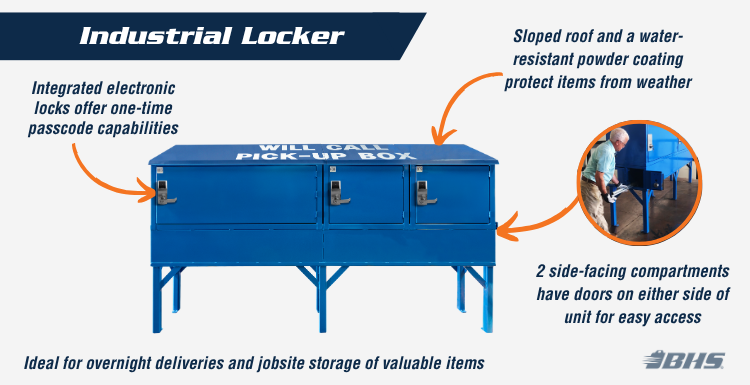
Handling deliveries or sharing expensive items after regular hours can create access issues. The BHS Industrial Locker (LKR-DB) helps solve this problem by providing strong, easy-to-use storage built for safe access anytime, day or night.
Made from heavy-duty steel with a weather-resistant coating and a sloped roof, it’s ideal for outdoor use and features electronic locks that can be opened with unique one-time codes.
For enhanced oversight and integration, optional IIoT-enabled smart locks bring advanced capabilities, allowing administrators to manage access remotely via phones, RFID cards, or company computers and generating detailed records for complete accountability.
Available with various standard compartment configurations, including options for extra-long items, the Industrial Locker delivers a highly adaptable and fortified solution for controlled-access storage requirements.
3. Implement Secure, Mobile Point-of-Use Tool Storage
Tools present a unique security challenge on bustling construction sites: They’re extremely valuable and portable, but they need to be accessible for work.
That means that leaving tools unsecured is unacceptably risky, transporting them off-site daily consumes valuable work time and logistical effort, and relying solely on distant, centralized static storage like shipping containers (such as Conex boxes) significantly hinders workflow and efficiency.
A more effective strategy: Deploy secure storage directly near active work areas. Portable Security Carts are designed precisely for this purpose, bridging the critical gap between security requirements and operational efficiency.
Product Recommendation: BHS Security Carts
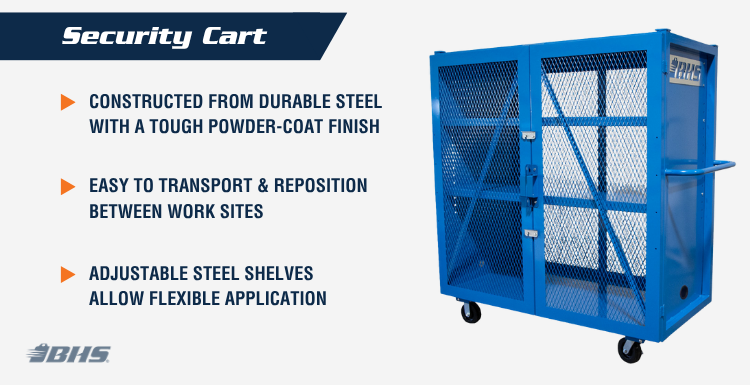
Securing valuable equipment and materials during active construction activities presents constant challenges. The BHS Security Cart (SEC) offers a direct solution: a portable, heavy-duty storage unit designed to protect assets from theft between uses.
Constructed from durable steel with a tough powder-coat finish — a significant upgrade from lighter mesh carts — it's built for demanding work environments and features robust, padlockable doors.
Standard equipped with heavy-duty casters and a push bar, its transport capabilities are greatly increased with optional fork pockets or lifting eyes, enabling efficient movement of heavy loads or across large sites via forklift or crane.
Inside, adjustable steel shelves hold various items, and doors swing open 180 degrees for easy access. Available in standard and heavy-duty models, with custom builds possible, the Security Cart delivers a rugged, adaptable solution for mobile asset protection.
4. Use Practical Techniques for Inventory Control
Effective tool management relies on consistency. If you can maintain careful ownership records and detailed, up-to-date inventory lists, you can track assets — but if your policies aren’t consistent, workers won’t use them. Even the best inventory platform can't help if assets aren't entered correctly.
Consider practical ways to keep your inventory lists accurate:
- Have a written inventory system. Implement formal check-in/check-out procedures, particularly for valuable or shared tools. Even if you’re running a fairly small site, keep a record of your inventory!
- Consistently mark high-value tools. Permanent company identifiers — ideally with asset ID tags or forensic marking —can deter theft (as marked items are harder to resell) and aid in recovery efforts if items are stolen and later found.
- Use tags. For high-value equipment, GPS trackers offer real-time location data, while simpler Bluetooth tracking tags might be considered for tool bags.
- Conduct regular physical inventory audits. Periodically comparing the actual tools present against your records helps identify discrepancies quickly. Use storage like Security Carts with mesh or expanded metal panels to allow for quick visual inventory checks.
- Utilize barcode or QR code scanning. Integrating scannable labels with your check-in/out system can improve speed and accuracy.
- Perform end-of-shift tool reconciliation. Ensure tools are accounted for and returned to secure storage at the close of each workday.
5. Foster a Security-Conscious Culture
Physical security measures and inventory controls provide essential layers of defense, but their effectiveness ultimately relies on the people who use them.
To minimize risks, construction firms need to build a workplace culture where security is a shared responsibility. You can start fostering that culture with regular training for all personnel (including subcontractors).
Key communication points should include:
- Clearly explaining all established site security protocols and procedures.
- Detailing how theft negatively affects project timelines and job security.
- Emphasizing the importance of remaining vigilant regarding potential security risks.
- Outlining the specific steps for promptly reporting suspicious activity or site vulnerabilities.
- Reinforcing that consistently following security rules helps prevent opportunistic theft.
- Stressing that every team member plays a crucial role in maintaining overall site security.
Prevent Construction Site Theft with BHS
Effective construction site security relies on layering procedures, personnel engagement, and — last but not least — appropriate equipment. Standard solutions like BHS Industrial Lockers and Security Carts provide robust answers for common storage and access control needs, but your strategy should take your site’s unique characteristics into consideration.
BHS engineers and manufactures custom storage solutions for specialized applications. We can modify existing products or design entirely new equipment tailored to your specific challenges — whether that involves accommodating oversized materials, integrating storage directly into a unique site workflow, or meeting exceptionally high-security requirements.
With over 45 years of experience, BHS delivers purpose-built equipment designed for tool theft prevention.
Request a quote online or call 1.800.BHS.9500 to discuss custom storage solutions to keep your site safe, secure, and productive.
