We use cookies to make your experience better. To comply with the new e-Privacy directive, we need to ask for your consent to set the cookies. Learn more.

Fleet Charging Areas: How Layout Affects Operational Efficiency
September 10, 2025
|
Categories: Blogs, Batteries, Chargers, Efficiency, Forklifts, EV Charging
The physical layout of an electric vehicle (EV) charging area will directly impact the efficiency of the fleet. In fact, it’s probably the single-most significant factor in determining your return on investment (ROI).
A poorly planned (or poorly equipped) charging area can create issues on day one, including:
- Increased vehicle downtime.
- Preventable safety incidents.
- A reduced lifespan for critical charging equipment.
An optimized charging area, on the other hand, will keep more of your fleet moving — and support your electrification strategy.

In this article, we’ll explain how you can design an appropriate layout for your facility’s charging areas by moving from a “refueling" mindset to a more holistic “integrated energy and logistics management" approach.
EV Charging Areas: The High Costs of Inefficiency
EV fleets are becoming more common for a simple reason: In many cases, the hard costs of fleet management are remarkably lower. Maintenance, fuel, and other predictable expenses can drive purchasing decisions, particularly in airports and other operations where EVs are catching on.
Of course, the soft costs of fleet management also play into the math. Some facts to keep in mind:
- By one estimate, downtime costs a fleet an average of $448 to $760 per day. That’s per vehicle — and a poor EV charging strategy can easily sideline multiple vehicles.
- In a survey from Qmerit, 64% of fleet professionals said they already have EVs in their operations.
- Only 7% reported that 20–50% of their fleet was electric in 2024. However, that number is expected to grow to 36% in 2025.
The current reality: More fleet managers are turning to electric, but many have failed to account for the soft costs of poor logistics. Fortunately, it’s an easy issue to address with high-quality, modular charging equipment and proper charging logistics.
Choosing Fleet Charging Areas (And Outfitting with Charging Equipment)
An efficient EV fleet depends on an efficient charging depot. The design process for these areas requires a systematic approach that considers your fleet's unique operational needs, both today and in the future. Success begins with a few foundational principles.
Start by analyzing your fleet’s specific energy requirements and traffic patterns. The types of vehicles you use, their daily routes, and their charging-port locations all influence layout.
Some questions to consider:
- Power & Cost: Where is our main power supply, and what is the cost to run service to different potential locations? Will our current electrical capacity support the chargers we need, or will we require a costly utility upgrade?
- Workflow & Traffic: Where do our vehicles naturally start and end their shifts? How can we place the depot to minimize travel time? Can we position it away from busy areas like loading docks to avoid congestion?
- Layout & Safety: Is there enough room in the proposed location for vehicles to maneuver safely? For indoor applications, does the location provide the necessary ventilation to meet safety standards?
- Future Growth: Does this location have enough physical space to add more chargers as our fleet grows in the future?
A depot that is designed without accounting for vehicle turning radii or logical traffic lanes can lead to collisions and wasted time. It’s also a best practice to separate charging areas from other high-traffic zones, such as loading docks, to improve safety and reduce congestion. Your MHE partner can help you make these calculations.

Related: EV Charging Station Design: 5 Considerations for Fleet Owners
Protect Your Fleet Charging Infrastructure with BHS
A charging depot built with purpose-built, modular infrastructure is not a secondary expense. It’s a foundational investment in the fleet itself.
By creating an organized, safe, and efficient environment, you maximize vehicle uptime and extend the life of expensive charging assets, which directly impacts your total cost of ownership (TCO).
Products to Consider:
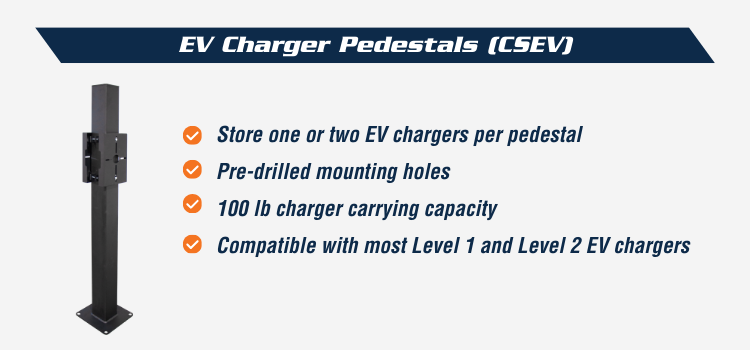
EV Charger Pedestals (CSEV): These space-saving pedestals have a small footprint and can be positioned anywhere a charging station is needed. Choose from models with and without cable management integration.
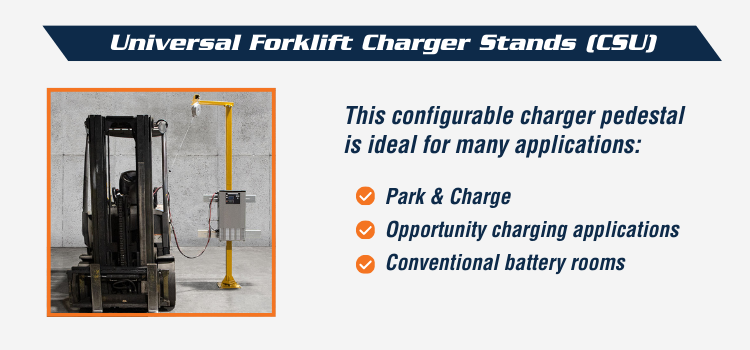
Universal Forklift Charger Stands (CSU): Today’s chargers come in many shapes and sizes. The CSU is a configurable charger pedestal that provides compact storage for any type of charging equipment. Designed as a modular system, it protects charging equipment while limiting space requirements and supporting scalability.
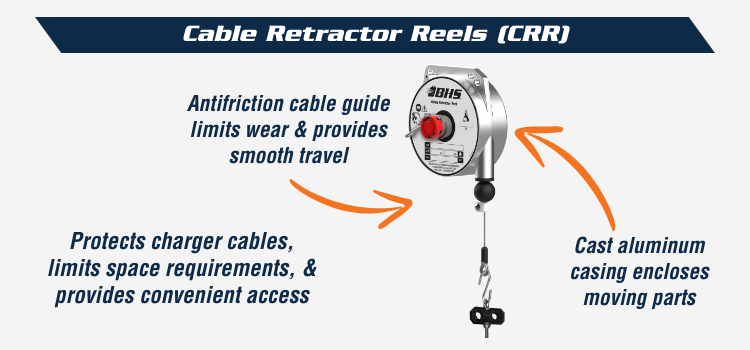
Cable Retractor Reels (CRR): Cable Retractor Reels keep charging cables safely elevated between uses while ensuring ergonomic access with every charge. A fully enclosed spring drum and antifriction cable guide provide long, reliable service life, while the safety suspension prevents cable drops in the event of a malfunction.
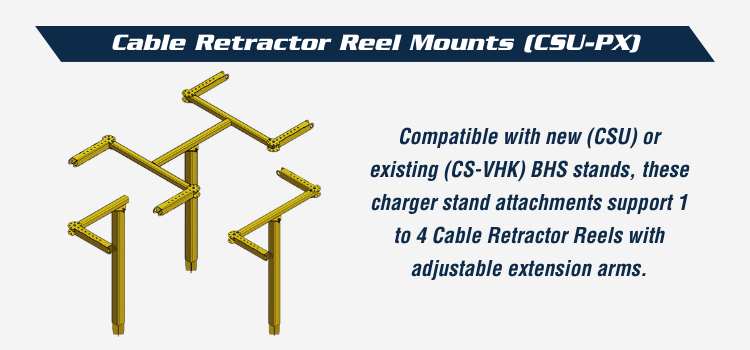
Cable Retractor Reel Mounts (CSU-PX): These charger stand attachments slot into new or existing BHS charger stands, with adjustable extension arms that support between one and four Cable Retractor Reels. The mount consists of multiple articulating arms that can be set in 45-degree increments across a 180-degree range, allowing you to place cable reels in the most convenient, ergonomically friendly position and safely lift cables out of traffic paths.
To get started planning your EV and forklift charging areas, contact the BHS sales team at 1.800.BHS.9500.
