We use cookies to make your experience better. To comply with the new e-Privacy directive, we need to ask for your consent to set the cookies. Learn more.

Choosing Custom Material Handling Equipment Manufacturers: 6 Questions to Ask
September 24, 2025
|
Categories: Blogs, Manufacturing, OSHA, Material Handling, Efficiency, Logistics, Management
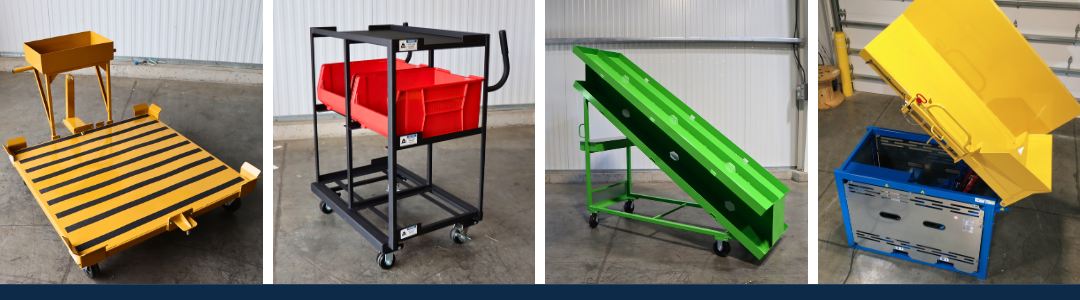
If you’re at the stage where you’re researching custom material handling equipment (MHE), you’ve exhausted the alternatives. You’re working with unique products and materials, or you need to handle them in a specific way. Standard MHE simply can’t handle the job.
Your options at this point are to change the way that your facility operates (which may not be realistic, practical, or cost effective) or find custom equipment that can meet your needs.
Here’s the good news: Custom MHE can deliver an excellent return on investment — provided that you’re working with a capable manufacturer that takes the time to learn about your business before offering solutions.
At BHS, we’ve specialized in custom material handling & forklift battery handling since our inception in 1979. We design and manufacture products at our 148,000-square-foot facility in St. Louis, Missouri — a state-of-the-art facility with laser technology, CNC machining, and robotic welders.
Our standard products are engineered to meet the needs of a wide range of warehouses, shipping centers, and other industrial businesses. However, we also recognize that some challenges require custom solutions.
Questions to Ask a Custom Material Handling Equipment Manufacturer
Below, we’ll discuss six questions that MHE manufacturers should be prepared to answer. We’ll also answer each question — and if you’ve got additional questions, we’re here to help. To discuss your material handling needs with an expert, call BHS at 1.800.BHS.9500 or request a quote online.
1. “What information do you need from us to fully understand our operational requirements and goals?”
Your MHE supplier needs to understand the intended application of the equipment. The key term here is understand; generally, you’re not just hiring someone to build to a basic set of specifications (although when that’s the case, our team can deliver: Read how we built material handling carts to exact specs for Alta Material Handling).
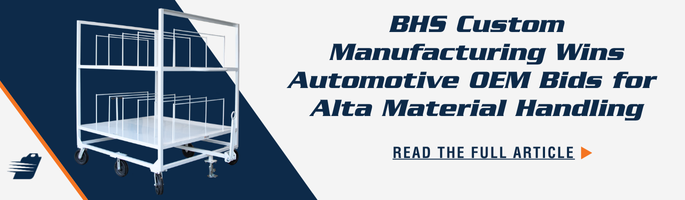
An MHE partner needs to help you solve a specific problem, which means that they need to fully engage with that problem in its context. You (or your end user) aren’t just paying for equipment: You’re paying for design and engineering. In some cases, engineers will be able to find a better way to address a material handling challenge — but only if they take the time to understand the operational goals.
Here’s an example of that approach: In 2018, BHS developed custom Tilt Tables for a Knapheide manufacturing line. Those tables were used to hold vertically oriented truck bodies during grinding, welding, and riveting.
That meant developing Lift Tables with heavy-duty rollers, along with a system to protect the table’s bearings from metal fragments. The tables also included a drift-free roller bed with an air stop that could keep truck bodies at the precise right placement on the roller bed for the work to be completed ergonomically. Read more about Knapheide’s custom Tilt Tables.
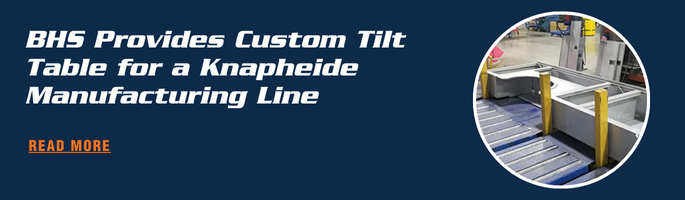
Each feature of the Tilt Tables was developed for the task at hand. If the equipment was built to simple specs, it wouldn’t have the engineering tweaks that allow for optimal efficiency, safety, and durability.
Your custom material handling equipment manufacturer should be prepared to outline their process — and ask plenty of questions about the application. Where possible, they should be willing to visit your worksite in order to replicate the application as effectively as possible.
That’s what sets BHS apart: We don’t make “widgets" for existing designs. We may start with a solution that we’ve designed before, but every aspect can be customized as needed.
2. “Do you outsource engineering, design, or quality assurance?”
At BHS, our engineering team is in house — as is our quality control team and dedicated support team.
We believe that it’s important to handle every aspect of design and engineering in house, because MHE fabrication is process-driven: Inconsistencies can add up quickly. Outsourcing leads to communication issues, which will almost certainly impact lead times and the overall quality of the build.
Each BHS team understands their role in the process. From design to quality assurance (QA), we prioritize a shared understanding of the end user’s goals. By handling everything in-house, we’re able to maintain consistent, fast lead times without sacrificing quality or personal communication.
3. “Will I have a consistent point of contact?”
You’ll work closely with your MHE team during the design and engineering processes, but you’ll also need a point of contact after the equipment is delivered.
If you’re an end user, you may need critical parts or additional customizations. If you’re a dealer, you may need support during installation — and if the manufacturer isn’t answering the phone, that’s bad for your bottom line.
BHS provides dealers and end users with consistent points of contact. Crucially, we don’t force people to wade through automated phone systems or talk to AI assistants to get answers. We’ve built our reputation through accessibility, and we’re available 24/7 via phone (1.800.BHS.9500) and the BHS Optima app.
4. “How do you approach ergonomics in your MHE designs?”
Ergonomics isn’t just about OSHA compliance (although compliance is certainly a major consideration, particularly for equipment that will see daily use). To maximize productivity and throughput, material handling equipment needs to position the work to the worker.
After all, no two human workers are exactly the same size and shape — so MHE should be designed with that reality in mind. That may mean adjustable heights and angles, or properly positioned handles that limit unnatural bending, twisting, and heavy lifting.
This also highlights the importance of understanding the application: By treating each material handling scenario as a unique challenge, MHE designers can make the tweaks that lead to safer (and more efficient) equipment.
Here are a few examples of ergonomic features we’ve incorporated into our standard and custom products:
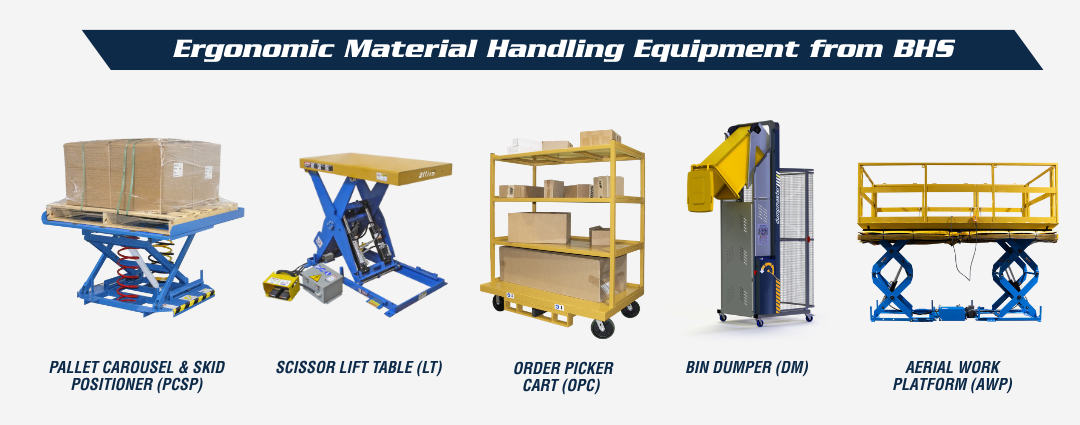
- The Pallet Carousel & Skid Positioner (PCSP) incorporates a self-leveling mechanism, available in either spring-actuated or pneumatic airbag-actuated models, which adjust the platform height as weight is added or removed. A 360-degree rotating tabletop allows workers to remain in a neutral posture while accessing all sides of the pallet.
- Scissor Lift Tables vertically position work at a precise, comfortable height tailored to each individual operator, adjustable through simple controls. Tabletop options including ball transfers, turntables, and roller conveyors create a secondary layer of ergonomic improvement by minimizing the push-and-pull forces required to maneuver heavy items.
- Order Picker Carts (OPC) feature lipped shelving on the sides and rear of the cart, which prevents items from falling during transport (and reduces the need for frequent bending on the part of the worker). Carts are also equipped with fork pockets and high-quality casters to improve maneuverability.
- Bin Dumpers are designed to fully automate the process of emptying heavy industrial bins, carts, and containers. This automates the entire lifting and tipping motion, which removes the severe risk of acute and chronic back and shoulder injuries associated with manually dumping heavy, bulky, and often unstable loads. We’ve designed Bin Dumpers with custom chutes, cradles, and guarding to minimize manual handling in specific applications.
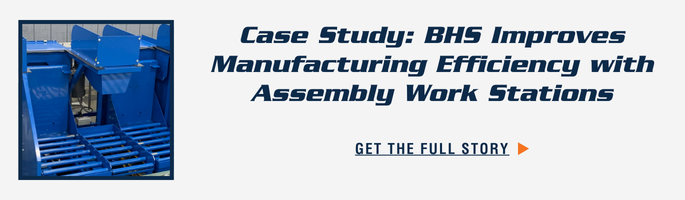
- BHS developed custom Assembly Work Stations for Connector Manufacturing, which provide employees with static access to components for safer and more efficient line-feeding assembly. Read the case study to learn about all of the ergonomic features of the custom Assembly Work Station.
These improvements weren’t just attempts to “check a box" for OSHA compliance: Each feature makes the MHE more efficient and easier to use. Ergonomics plays a major role in every BHS design, and worker safety is part of our manufacturing culture.
Learn more: How Better Warehouse Ergonomics Improves Productivity
5. “What is your quality assurance process, and can it be adapted to our application?”
With custom equipment, quality assurance processes must adapt to the application. While manufacturers may not be able to replicate the application of the equipment perfectly, they should do their best to replicate the loads during the testing process. They should also take steps to ensure that their QA process is aligned with the customer’s expectations.
All BHS custom products have an extensive quality assurance form. The level of customization affects the quality assurance process, but QA is always comprehensive: From load capacities to form, fit, and function, we’re invested in providing high-quality products that we can stand behind.
6. "How do you estimate lead times, and when do lead times begin?”
Needless to say, there’s no such thing as a “standard lead time" for custom equipment. Developing and fabricating a custom Vertical Reciprocating Conveyor (VRC) will necessarily take more time than adjusting an Order Picker Cart (OPC) to handle unconventional products — so custom equipment lead times will vary depending on the application.
However, manufacturers should be upfront about their capabilities and provide clear, accurate lead times. At BHS, we start each project by asking a simple question: “When do you need it?”
If we’re unable to meet the end user’s timeframe, we communicate that immediately. Of course, that’s usually not the case: Our 148,000-square-foot facility in St. Louis, Missouri is fully outfitted to create high-quality, durable equipment, and our team knows how to design, build, and test MHE. After all, custom orders make up a significant percentage of our overall sales — and we build much of the equipment for our own operation. We understand how the right MHE can make a difference.
Just as crucially, we prioritize open communication with our dealers and end users. Our lead times always start from the approval of the design drawings, so users have the accurate estimates they need for scheduling.
Your Partner for Custom Material Handling Equipment
BHS has a network of expert dealers, a state-of-the-art manufacturing facility, and a strong reputation for our commitment to build quality and ergonomics. However, our success as a custom MHE manufacturer can be mostly attributed to one factor: We recognize that each material handling challenge is unique and requires a purpose-built solution, not just a product.
To that end, we take a personal approach, working directly with both end users and dealers to ensure that each solution is ready to contribute to operational efficiency on day one. With extensive quality assurance and exceptional after-delivery support, we provide a partnership that our clients can depend on for the entire lifecycle of their equipment.
If you need material handling equipment — or you’re exploring whether you need a custom solution — talk to us. Call BHS at 1.800.BHS.9500 or request a quote online to start the conversation.
