We use cookies to make your experience better. To comply with the new e-Privacy directive, we need to ask for your consent to set the cookies. Learn more.

Choosing a Forklift Charger and Matching Infrastructure
July 1, 2025
|
Categories: Blogs, Batteries, Chargers, Efficiency, Maintenance, Safety
To move materials efficiently, you need the right material handling equipment (MHE) — and in most warehouses and other industrial operations, that means electric forklifts.
Lift truck performance, reliability, and return on investment (ROI) is directly linked to the effectiveness of the battery charging system. Put simply, you need to keep your fleet on the floor; maximizing operational uptime requires a thoughtful approach to both your chargers and the supporting infrastructure.
In this article, we’ll discuss the three major types of electric forklift charger technologies. We’ll also explore how modular, flexible charger stands can help you adapt to evolving operational needs.
Forklift Charger Types: Choosing Between FR, SCR, and HF
Three types of forklift chargers are commonly found in warehouses: FerroResonant (FR), Silicon-Controlled Rectifier (SCR), and High Frequency (HF). These technologies have distinct advantages and disadvantages for different types of operations:
Ferroresonant (FR) Forklift Chargers
Ferroresonant technology is the standard approach to forklift battery charging. These chargers use a large, specialized transformer to regulate power through magnetic saturation. The design is simple, robust, and common — if you’re not sure which type of battery charger you’re currently using, it’s likely an FR charger or an SCR charger (discussed below).
Advantages:
- Most FR chargers are relatively inexpensive upfront. Industrial units start around $1,500.
- The simple, robust design is highly reliable.
- FR technology handles voltage fluctuations relatively well.
Disadvantages:
- FR has the lowest energy efficiency (typically 75-80%, according to one manufacturer), so you’ll pay more for electricity over time.
- They have a relatively large footprint.
- Limited compatibility; FR is primarily suited for flooded (wet cell) lead-acid batteries, not sealed lead-acid batteries (AGM and gel cell).
- They’re generally restricted to slower, conventional charging cycles.
- FR generates considerable heat during operation.
Best For: FR chargers are most suitable for single-shift applications using only flooded lead-acid batteries where basic overnight charging is sufficient. They’re the standard for a reason: In industrial facilities that use conventional charging, the advantages of other charger technologies don’t really outweigh the lower upfront costs.
Silicon-Controlled Rectifier (SCR) Chargers
If you need more control than an FR charger offers, Silicon-Controlled Rectifier (SCR) technology might be the answer. SCR chargers use semiconductor controls (the SCRs) to manage the charging process more precisely than FR units.
Advantages:
- They offer better charging control than FR chargers.
- They're compatible with all common types of lead-acid batteries (flooded, AGM, and gel cell).
- Many SCR units support opportunity and fast charging strategies.
Disadvantages:
- They're still fairly large and heavy compared to modern HF units.
- The higher ripple current they produce can sometimes lead to increased battery heating.
- Their circuitry is more complex than basic FR chargers.
Best For: SCR chargers work well if you're running different types of lead-acid batteries (both flooded and sealed) in your fleet. They're a solid choice if you need more flexibility than just basic overnight charging — like using opportunity charging during breaks — and want a balance between upfront cost and overall performance.
High Frequency (HF) Chargers
High Frequency (HF) chargers use advanced electronics switching at very high frequencies, which allows for big improvements in efficiency, size, and flexibility compared to older technologies. While they’re more expensive upfront, they can reduce costs over time: Energy consumption alone can account for 15% to 30% of overall facility management costs in some distribution centers.
Advantages:
- They boast the highest energy efficiency (often 90-95% or more).
- The compact, lightweight design saves valuable floor space.
- You get maximum flexibility — they work with all common battery types.
- They effectively support all charging strategies (conventional, fast, and opportunity).
- Many are modular, allowing you to scale capacity or easily replace parts.
- More control can mean lower chances of overcharging and boilovers.
Disadvantages:
- HF chargers typically have the highest upfront cost.
- Your grid matters: The complex electronics might be more sensitive to things like unstable power or very harsh environments compared to simpler FR chargers.
Best For: HF chargers really shine in busy, multi-shift operations where you need maximum uptime, especially if you rely on fast charging or opportunity charging.
You might choose HF if saving on long-term energy costs and maximizing floor space are high priorities for your facility — though optimization of other charger infrastructure (discussed below) can help with floor space, too.
Choosing Forklift Charger Stands: Key Factors
Forklift Charger Stands are not just storage fixtures: They’re essential components for maintaining an organized, safe, and efficient charging operation. The stand choice directly impacts workflow, operator ergonomics, space utilization, and safety compliance.
Different stand configurations cater to specific operational needs:
- Floor-Mounted Shelves/Stands: Provide stable, accessible support, particularly well-suited for heavier charger models requiring a solid foundation.
- Wall-Mounted Brackets: Optimize floor space by elevating chargers, ideal for lighter or more compact charger designs where wall structure permits.
- Multi-Tier Stands: Maximize vertical space in dedicated charging areas, significantly increasing charger density per square foot.
- Vertical Mounts: Minimize footprint by orienting chargers vertically, often utilized with compact models in park-and-charge scenarios.
Selecting the appropriate stand requires aligning its features with both the charger's physical requirements (weight, dimensions, ventilation needs) and the facility's charging strategy. Point-of-use stands facilitate opportunity charging workflows, while dedicated battery rooms often utilize higher-density floor or multi-tier stands for conventional charging routines.
Products to Consider:
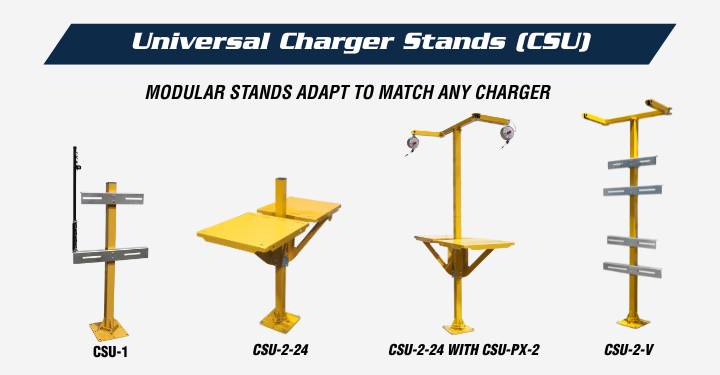
BHS Universal Forklift Charger Stand (CSU)
Designed for flexibility, the CSU pedestal stand is truly modular charging infrastructure. The key advantage: configurability.
The CSU securely supports virtually any charger design or brand with a minimal footprint. Enhance space efficiency by mounting up to two chargers on shelves, or up to four chargers using the horizontal brackets (adjustable for securing points between 8” and 27” wide) on a single compact pedestal.
Choose between heavy-duty flat shelves (standard 24" or 36" sizes, 300 lb capacity each, custom available) or versatile horizontal wall mounts. The uniquely adaptable design ensures facilities can easily accommodate new charger technologies or fleet changes without replacing the core infrastructure.
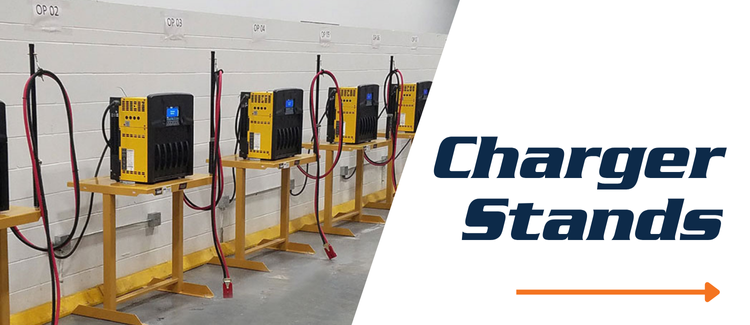
Constructed from heavy-gauge steel with a durable, acid-resistant powder-coat finish, BHS Charger Stands provide a robust foundation for various charger sizes and weights.
These floor-mounted units are engineered for stability with pre-drilled anchoring holes and feature generous shelf depths to accommodate various charger models.
BHS Wall Mount Charger Brackets (CWB)
BHS Wall Mount Charger Brackets provide secure mounting for compact charger models. Designed for easy installation on suitable facility walls, they’re available with galvanized or powder-coated steel construction for a lifetime of service.
BHS Vertical Charger Mounts (VCM)
The VCM heavy-duty steel mount is well-suited for space-constrained areas or integrated park-and-charge stations, providing convenient operator access while keeping chargers secure and off the floor.
The VCM-1 supports a single charger, while the VCM-2 holds two chargers firmly within a single unit.
Build a Better Approach to Battery Handling with BHS
There are about 856,000 forklifts operating in the United States alone. Those machines need excellent charging infrastructure to provide an ROI — and modular charger stands can accommodate growth while allowing operations to take advantage of next-generation charging technologies.
Adaptable charger stands and effective cable management can ensure safety, support compliance, and help your organization build more efficient workflows.
To discuss custom solutions with a member of our team, call 1.800.247.9500 or request a quote online.
