We use cookies to make your experience better. To comply with the new e-Privacy directive, we need to ask for your consent to set the cookies. Learn more.

A Guide to Warehouse Mezzanine Material Handling
November 19, 2025
|
Categories: Blogs, Ergonomics, Manufacturing, Material Handling, Efficiency, Logistics
The global market for warehouse mezzanines continues to grow — as do the warehouses themselves. Operations that leverage vertical space can simply handle more product, but better space utilization doesn’t always translate to greater efficiency.
Once you add a second level, you add a logistical challenge: how to move materials and products between floors safely, efficiently, and cost-effectively.
A poor mezzanine material handling strategy leads to dangerous working conditions and frustrating bottlenecks. If you’re serious about building a vertical warehouse, you need to carefully evaluate the features of your material handling equipment (MHE), assessing everything from engineering and load capacity to safety compliance and long-term operating costs.
At BHS, we’ve built our business by recognizing that no two businesses operate in precisely the same way — and by providing custom MHE solutions that help warehouses increase throughput and maximize storage space. That extends to our lineup of Vertical Reciprocating Conveyors (VRCs), which can be fully customized to slot seamlessly into your material handling flow.
Today, we’ll review the three main MHE options for warehouse mezzanine materials: basic manual tools, VRCs, and full-fledged freight elevators. To find a solution for your facility, call 1.800.BHS.9500 to speak with a member of our team.
1. Manual and Light-Duty Mezzanine MHE: Forklifts & Hoists
If you’re using mezzanines infrequently (or if you’re forced to use vertical space by necessity), you might rely on existing equipment like forklifts or install a simple mezzanine hoist as a simple, low-cost solution.
But by using forklifts, you tie up a valuable piece of equipment and a certified operator. That leaves them with less time for critical tasks like loading and unloading trucks.
Depending on the layout of your facility, you might also introduce a significant operational bottleneck — and potential safety risks. Maneuvering a forklift requires precision, and there’s always a danger of pallets being pushed too far and falling from the mezzanine edge.
A mezzanine hoist, which is essentially a winch-and-cable system, is a more dependable option. Hoists are specialized equipment, and they can work well; with that said, they’re often slow, and they have very limited weight capacities. When evaluating hoists, make sure they have appropriate safety mechanisms like interlocked gates, which prevent operation when doors are open, or drop-stop features to catch a load in the event of a failure.
However, if you’ve got a facility with a regular flow of goods to an upper level, you’re better served by a long-term solution.
2. Vertical Reciprocating Conveyors (VRCs): A Balanced Solution for Mezzanine MHE
For the vast majority of warehouse and industrial facilities, the Vertical Reciprocating Conveyor (VRC) provides the perfect balance of cost, performance, and safety.
A VRC is a specialized freight lift engineered exclusively for transporting materials — never people. Because VRCs are not designed for human transport, they are governed by the ASME B20.1 safety standard for conveyors, not the much stricter and more complex ASME A17.1 elevator code. This makes VRCs significantly less expensive to purchase, install, operate, and maintain.
By dedicating a VRC to vertical transport, you free up your forklifts for their intended tasks and create a safer, more organized, and more efficient workflow. Here, you’ve got two options: Hydraulic VRCs and electromechanical units.
Hydraulic VRCs
Hydraulic VRCs utilize a reliable pump system to lift and lower the carriage. The straightforward design of a hydraulic VRC makes it an exceptionally cost-effective choice for most general applications.
- Look for: A system purpose-built for two-level operations. Hydraulic lifts are the ideal mezzanine material handling solution. Their smooth, steady movement is also beneficial for transporting more delicate or unstable loads.
- Consider: Your load requirements and workflow. These lifts are workhorses, perfectly suited for moving palletized loads, carts, totes, and other common warehouse items weighing up to 6,000 pounds.
Products to Consider: Hydraulic Cantilever Vertical Reciprocating Conveyor (VRC-HC)
Start utilizing vertical space with the Hydraulic Cantilever Vertical Reciprocating Conveyor (VRC-HC). This lifting solution ships pre-assembled, so you can simply secure the base and connect the power to get started. It's ideal for moving pallet loads, heavy equipment, and loose materials between levels, delivering a rapid ROI for mezzanines and multi-story applications up to 15 feet.
Designed for space efficiency, the two-post cantilever VRC features a compact footprint while supporting high-throughput operations. Choose between 3,000 or 6,000-pound capacities and three standard carriage sizes to fit common materials, pallets, or carts. With travel speeds of 21 feet per minute and robust safety features like interlocks and emergency drop locks, this US-made VRC provides a powerful, reliable, and hazard-free material handling solution.
Mechanical VRCs
Mechanical VRCs employ a heavy-duty motor and a robust chain or cable system to move the carriage. They tend to require a higher initial investment than their hydraulic counterparts, but mechanical VRCs deliver superior power, speed, and durability for more demanding, high-frequency applications.
- Look for: High-capacity, high-speed performance. Mechanical VRCs are the preferred choice for servicing multiple stories or integrating into automated conveyor systems where cycle speed is critical.
- Consider: Your operational intensity. If your facility requires continuous, high-speed vertical transport to keep pace with production or distribution, a mechanical VRC is the superior option.They are engineered for high-cycle, continuous-duty environments and can be customized for virtually any load size or weight.
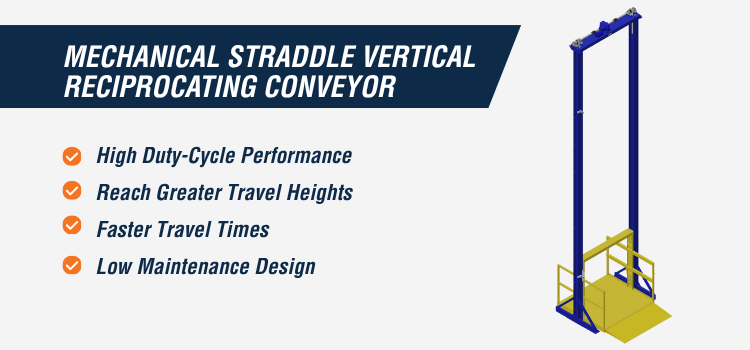
Products to Consider: Mechanical Straddle Vertical Reciprocating Conveyor (VRC-MS)
The Mechanical Straddle VRC (VRC-MS) delivers high-throughput conveyance with low maintenance requirements. Its mechanical lift system provides a fast travel speed of 28 feet per minute and is engineered for taller applications, effortlessly moving loads up to 25 feet.
The VRC-MS supports 3,000 or 6,000-pound capacities, and its two-post straddle design accommodates four expansive carriage platform options up to 90" x 96" for oversized carts or bulky materials. Equipped with advanced safety features, including chain tension sensors that monitor integrity and an emergency cam catch that arrests the platform in the unlikely event of a chain failure.
To learn more about the differences between hydraulic and mechanical VRCs, read: Hydraulic VRC Vs. Mechanical VRC: Choosing a Vertical Lift
3. High-Investment Mezzanine MHE: Freight Elevators
A freight elevator, sometimes referred to as a mezzanine elevator, performs the same essential function as a VRC but is designed (and certified) to transport workers alongside materials.
That introduces a cascade of regulatory requirements and expenses. Freight elevators must meet the ASME A17.1 elevator code, which means they must feature fully enclosed shafts, in-cab controls, emergency communication systems, and appropriate braking mechanisms.
The installation process is far more involved and expensive, and in most applications, the long-term cost of ownership is significantly higher due to mandatory inspections by licensed elevator technicians.
If your operational process absolutely requires an employee to ride with the product between levels — for instance, to operate a piece of equipment—then a freight elevator is necessary. For the vast majority of material-only transport scenarios, vertical reciprocating conveyors make more sense.
Mezzanine Material Handling Solutions from BHS, Inc.
If you’ve decided to “go vertical,” you’re dealing with a lot of inventory, and you need low-footprint equipment that will allow you to maintain efficiency as you scale. Relying on forklifts and manual labor will almost certainly reduce throughput — you need MHE that’s specifically designed for the job at hand.
As a family-owned business — and as a manufacturer that utilizes vertical storage at our own facility — we understand the importance of custom solutions. To that end, we engineer material handling equipment to meet the specific demands of your facility.
That means choosing a traffic pattern that complements your material flow, assessing lift height and load capacity, and ensuring that each solution meets your requirements for travel speed and duty cycle.
Our VRCs are constructed with all-steel components for maximum durability and are equipped with a suite of robust safety features, including mechanical drop locks and sensors that ensure gates are securely closed before travel, all in full compliance with ASME B20.1 standards.
Ready to transform your facility? Contact the BHS sales team at 1.800.BHS.9500 or request a quote online to find custom solutions for your facility.
