We use cookies to make your experience better. To comply with the new e-Privacy directive, we need to ask for your consent to set the cookies. Learn more.

5 Ways to Reduce Warehouse Picking Error Rates
January 21, 2026
|
Categories: Blogs, Ergonomics, Material Handling, Efficiency, Logistics, Management
Order picking efficiency directly affects the throughput and responsiveness of any distribution center. Whether a facility relies on manual processes or advanced automation, the speed at which products reach customers — and the cost to get them there — depends heavily on your picking workflow.
As every warehouse management professional knows, picking is also the most expensive component of warehouse operation. Studies have found that the picking process is accountable for up to 55% of all operating costs, though automation has shifted this ratio in recent years.
Because order fulfillment relies on human labor and judgment, it is vulnerable to picking mistakes. High warehouse picking error rates lead to product damage, costly returns, and eroded customer satisfaction. Packing errors do the same.
To protect margins and reputation, fulfillment managers must implement standard operating procedures that keep order accuracy rates high. Here are a few picking and packing strategies that can reduce human error.
How can Picking and Packing Errors Be Reduced at Your Warehouse?
These five practices will help to keep your picking and packing processes free of mistakes, so you can move orders as efficiently as possible.
1. Streamline Warehouse Layout and Product Slotting
A disorganized facility guarantees excessive travel time and heightens the risk of fulfillment errors. To combat that, implement storage strategies like ABC analysis: store fast-moving items ("A" items) in the most accessible pick locations, closest to packing and shipping stations. Reducing the physical complexity of the environment allows pickers to focus on warehouse picking accuracy rather than navigation.
- Establish a logical flow from receiving to shipping to minimize backtracking and take advantage of warehouse space optimization.
- Optimize layout organization by clearly labelling aisles with scannable rack labels.
- Group items frequently bought together in neighboring slots to reduce travel.
- Regularly adjust slotting strategies based on changing demand patterns, ideally based on real-time inventory visibility.
2. Implement Efficient Picking Methodologies
One size does not fit all when it comes to order fulfillment. You’ll need to find a methodology that best suits your specific volume, package dimensions, and order profile.
- Batch Picking: Operators consult a pick list to collect items for several orders in a single pass through the warehouse, which reduces travel time.
- Zone Picking: The warehouse is divided into pick zones, and pickers work only within their assigned area. That allows workers to become experts on specific SKUs, reducing misidentification.
- Wave Picking: Orders are grouped into "waves" based on criteria like shipping cost, carrier, or order list commonalities to smooth out productivity levels throughout the shift.
- Single Order Picking: While it requires more travel, having a picker complete one full order before starting another minimizes sorting errors for discrete, complex orders.

Related: Warehouse Picking Systems: 6 Strategies and the Tools That Support Them
3. Leverage Technology for Verification
There’s an unfortunate paradox at play in most warehouses: As human workers spend more time on the job, they get faster — but they’re often more prone to errors.
That’s largely because experienced workers make assumptions about their accuracy. Barcode technology (i.e., barcode labels, scanners, and order management software) provides another layer of verification without requiring much extra effort from workers.
- Equip workers with barcode scanners that help them immediately match SKUs to the order list.
- Use system alerts to catch wrong SKU selections before they move downstream to the packing process.
- Apply verification layers specifically for broken case picking, and integrate results with inventory management systems to ensure real-time accuracy.
Other pick-and-pack technology that can improve accuracy rates includes autonomous mobile robots, cloud warehouse automation solutions, light-directed picking systems, voice picking systems, RFID tags, and indoor wayfinding systems.
4. Prioritize Ergonomics and Worker Support
Humans get fatigued, and fatigue can quietly impact accuracy. Non-ergonomic equipment forces awkward movements, leading to physical strain, injury, and a loss of focus that results in errors. It is especially critical to maximize productivity levels, given that the warehousing and storage sector has seen employment drops of 2.1% year-over-year.
When pickers can access items comfortably and safely, total warehouse picking accuracy improves. To maintain low error rates, equip your workforce with material handling solutions that reduce the strain of manual processes that lead to worker injuries.
- Provide material handling equipment that moves easily with the worker to reduce fatigue. For high-volume fulfillment, Order Picker Carts with smooth-rolling casters minimize push/pull forces, while Stock Picking Carts with integrated ladders can prevent dangerous overreaching.
- Ensure carts and aids feature comfortable handle heights and smooth casters.
- Focus on ergonomics to prevent physical strain, maintain focus during shifts, and reduce fulfillment errors at the picking and packing stages.
Read More: Warehouse Ergonomics: Order Picking and Pallet Building Safety Tips
5. Enhance Staging Area Organization
Staging is the final step before loading, but the Quality Control (QC) station is the true checkpoint in the fulfillment process. The moments before an order enters the staging lanes represent the last opportunity to ensure order accuracy before an order leaves your facility.
- Perform final verification at the packing station, cross-referencing items against packing slips and double-checking the shipping label, prior to staging.
- Use the staging area strictly for organizing verified orders by carrier or route.
- Mark lanes clearly to prevent mix-ups during the final loading process.
Material Handling Solutions from BHS, Inc.
At BHS, we engineer material handling equipment designed to support ergonomic workflows and high-accuracy picking.
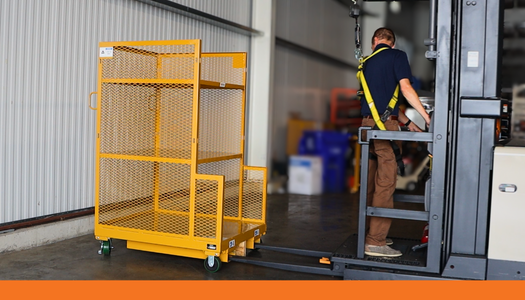
Order Picker Carts (OPC): Designed for high-throughput environments, these carts feature heavy-duty steel construction capable of supporting 3,000 pounds. The expanded metal design provides visibility of contents, while lipped shelving contains merchandise securely during transport.
Stock Picking Carts (SPC): Ideal for operations that require unit-by-unit stocking or picking, these carts often feature integrated step ladders for immediate access to overhead spaces. They are built to simplify the act of placing or retrieving products from shelves, supporting both picking and restocking tasks.
Order Picker Platforms (OPP): The OPP attaches to existing order picker trucks to provide an expanded, OSHA-compliant work surface. This upgrade ensures workers are positioned safely and ergonomically when accessing vertical storage, offering a more secure platform than standard pallets.
Ready to lower your warehouse picking error rates? We’re here to help. Contact the BHS sales team at 1.800.BHS.9500 to discuss material handling equipment and custom solutions for your picking process.
