We use cookies to make your experience better. To comply with the new e-Privacy directive, we need to ask for your consent to set the cookies. Learn more.

OSHA Requirements for Testing Industrial Lifting Equipment
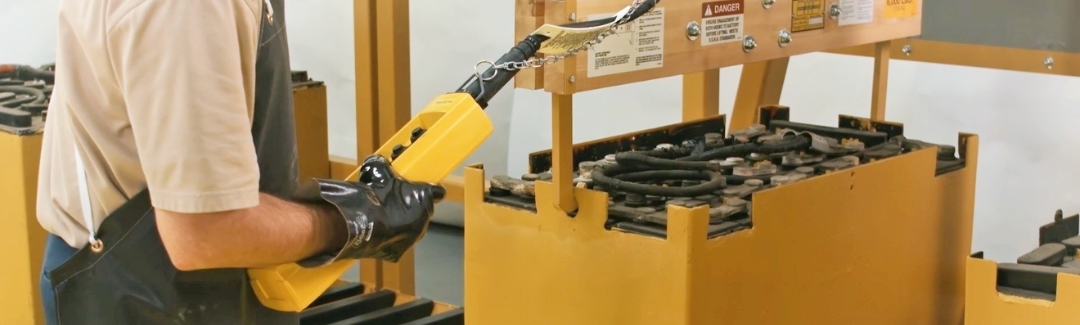
You can't leave anything to chance in an industrial setting. The material handling equipment you need to keep shipments moving in a warehouse, or to send raw materials down the line in a manufacturing facility, has to be tested before it's put into daily use.
That's not just common sense; it's also the law. It might not surprise you to learn that the Occupational Safety and Health Administration is very clear about material handling equipment in the workplace. Not only must every Gantry Crane, pallet jack, aerial lift, Lift Table, and forklift battery handling device stand up to strict proof tests, they must be periodically inspected to make sure they remain safe to use, even after years of hard lifting.
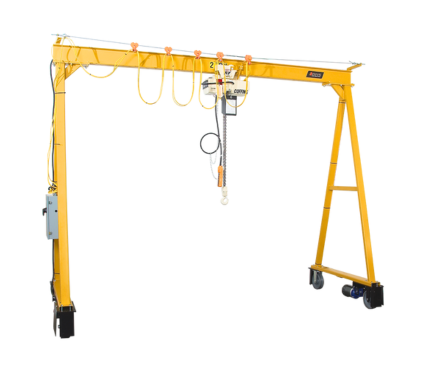
Here's what you need to know about testing your valuable lifting equipment in accordance with OSHA guidelines.
OSHA Lifting Device Inspection Requirements
The following OSHA standards address testing and inspection for material handling equipment, but this isn’t a comprehensive list. Still, these examples can give you a good idea about how OSHA addresses lifting device testing requirements.
-
Before being deployed for daily duties, gantry cranes should undergo load tests with weights that exceed tthe manufacturer's given load capacity. However, 29 CFR 1910.179(k)(2) prohibits employers from using test loads above 125 percent of the rated load, unless manufacturers specifically recommend otherwise.
-
That 125 percent figure comes up again in the OSHA standards — this time in a slightly different context. Any lifting accessory (custom grips, for instance, or specially designed hooks, clamps, or slings) must be proof-tested up "to 125 percent of their rated load." That's according to 29 CFR 1926.251(a)(4), a standard developed particularly for the construction industry. However, absent a similar rule for general industry, this standard may be applied just about anywhere.
-
If you use a Gantry Crane with a custom lifting accessory, then, you'll want to test it with a load of precisely 125 percent of the manufacturer's load capacity. Going over 125 percent would violate 29 CFR 1910.179(k)(2), while failing to go right up to that point wouldn't meet standard 1926.251(a)(4).
-
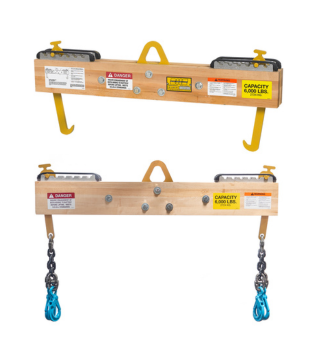
There are notable exceptions to the testing requirements for lifting accessories. If you use a lifting beam that isn't custom-designed for your application, you don't need to proof-test or mark the weight limit with capacity stickers or stamps. A standard lifting beam from a reliable manufacturer doesn't need to be tested (although the lifting device it's attached to probably does).
-
Don't worry too much about the type of weight you use to proof test your gantry cranes against the manufacturer's rated capacity. In 2004, Jeff Moser, Director of Corporate Safety, Training, and Education at a Pennsylvania heavy construction outfit, wondered if federal regulations specify certified weights for official proof tests. They don’t, wrote Russell Swanson, Director of Construction at OSHA. "The standard does not specify any particular means of determining the weight of the load being tested," he wrote in response to Moser's letter of inquiry. "Therefore, any method that can be reasonably expected to yield sufficiently accurate and reliable data to establish the weight of the load may be used for the proof-test."
Note that this list only includes guidance from OSHA. Manufacturers also follow other industry standards. For example, ASME Standard B30.20 provides rules for building and testing below-the-hook lifting devices.
How Often Jacks Must Be Inspected, According to OSHA?
Stationary and pallet jacks are common forms of material handling equipment in many industries. What does OSHA have to say about the inspection frequency for these lifting devices?
The OSHA safety regulations for general industry provide a rough schedule about how often jacks must be inspected. Standards for the construction industry do the same, and with the same wording.
The jack standard for general industry is 29 CFR 1910.244(a). The construction jack safety regulation is 29 CFR 1926.305. So do these standards apply to pallet jacks as well as stationary lifting equipment?
The 1910 standard certainly does. In 2017, OSHA issued a fine of $5,795 to an employer that failed to post rated loads on manual pallet jacks, in accordance with 29 CFR 1910.244(a)(1)(ii). (This standard requires load limits to be posted via "casting, stamping, or other suitable means" like capacity stickers or a similar capacity marking.)
Given the identical wording of standard 1910.244(a) and 1926.305, it stands to reason that the construction safety standard would cover pallet jacks just like the general industry regulation.
The 1926 standard is a little more specific about the equipment it covers, however. It’s specifically about “jacks — lever and ratchet, screw, and hydraulic.” Pallet jacks are generally hydraulic jacks, so this standard is very likely to cover them.
So now that we know these two standards apply to stationary jacks and pallet jacks, let’s look at what they have to say about when pallet jacks must be inspected.
-
Inspection timelines depend on “service conditions,” so there are different requirements based on specific usage.
-
If you keep a jack at a single location, it must be inspected at least once every six months, regardless of how often you use it.
-
If a jack is sent out to a second location, you must inspect it before it leaves and after it comes back.
-
Jacks must be inspected just before and right after any “abnormal load or shock.”
In addition to these inspection schedules, staff must inspect any repair or replacement parts in pallet jacks — and pallet jacks that aren’t safe to use must be tagged and set aside until repairs are verified.
If you’re interested in the inspection requirements for pallet jacks, you might also wonder about standards for lifting materials — and virtually every industrial operation works with pallet loads. As we comb through the OSHA standards, then, we can also look for guidance on handling pallets.
Is There an Industry Standard for Lifting Pallets?
Unfortunately, OSHA doesn’t have a standard that specifically covers material handling for pallets — unless you count the General Duty Clause, which requires employers to keep workplaces “free from recognized hazards.”
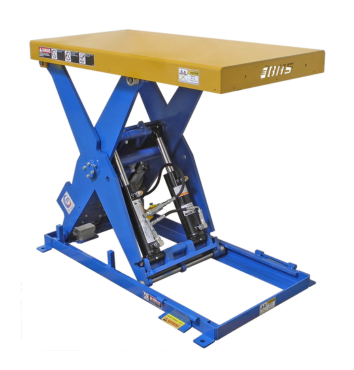
So while there isn’t a specific OSHA standard — as in regulations — for handling pallets, there are general standards — as in best practices — that have developed in the material handling industry. These include:
- Wherever possible, only handle pallets with forklifts or pallet jacks.
- If you must lift a pallet manually, don’t exceed limits set by the NIOSH Lifting Equation.
- More simply, OSHA suggests a two-person lift for objects heavier than 50 pounds — which wooden pallets certainly are, and plastic pallets may be.
- Inspect wooden pallets for splinters and nails prior to manual lifts.
- “Two-way” pallets provide access to lift truck/pallet jack forks on only two edges. “Four-way” pallets can be lifted from any of the four edges. Know which you’re working with prior to attempting a lift.
In addition to using forklifts and pallet jacks to transport pallets, you can greatly improve safety during palletizing and depalletizing with Pallet Courousels and Skid Positioners. These self-leveling turntables allow you to keep work at a comfortable position as you build or unload pallets. 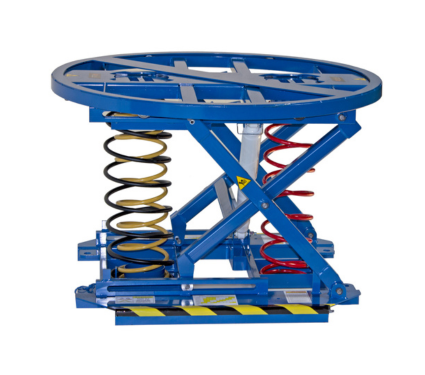
So while there may not be a legally enforceable industry standard for lifting pallets, exactly, you can improve workplace safety by following general best practices for material handling.
As you can see, these OSHA standards can get complicated. Talk to your OSHA compliance officer for more details. To learn more about the extensive testing that BHS conducts on every Gantry Crane, Lift Table, and Battery Extractor we build, browse our catalog, or call the BHS Sales Team at 1.800.BHS.9500.
References:
"Overhead and gantry cranes - 1910.179." OSHA. Occupational Safety and Health Administration, United States Department of Labor, n.d. Web. 21 May 2016.
"Rigging equipment for material handling - 1926.251." OSHA. Occupational Safety and Health Administration, United States Department of Labor, n.d. Web. 21 May 2016.
Swanson, Russell. "Standard Interpretation - Standard Number: 1926.251; 1926.251(a)(4); 1926.32; 1926.32(g)." OSHA. Occupational Safety and Health Administration, United States Department of Labor, 9 Feb. 2004. Web. 21 May 2016.
