We use cookies to make your experience better. To comply with the new e-Privacy directive, we need to ask for your consent to set the cookies. Learn more.

Platform Carts Vs. Furniture Dollies for Industrial Material Handling
July 20, 2022
|
Categories: Blogs, Ergonomics, OSHA, Material Handling, Efficiency, Safety
Every year between 2015 and 2018, well over 60 percent of warehouse and distribution center operators invested significantly in material handling equipment. That’s not a surprise; handling materials is the core function of these facilities, and unassisted heavy lifting can be inefficient, costly, and downright dangerous.
While forklifts and automated guided vehicles may be ideal for moving goods throughout industrial plants, sometimes the right tool for the job is simpler. Sometimes you just need a cart: a hand-pushed, wheeled vehicle that allows a single operator to move high-volume goods or large, heavy items.
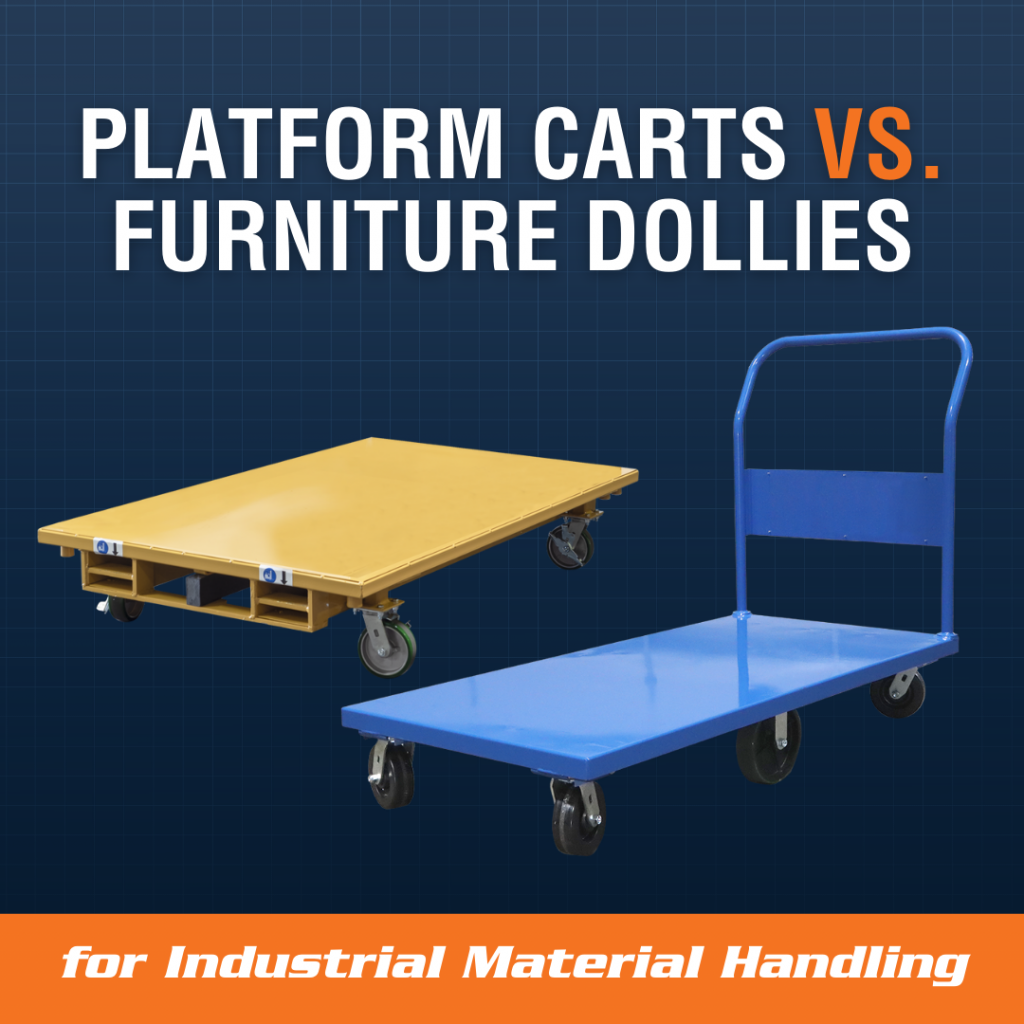
The question is, what type of cart is ideal for the materials you need to haul? While multi-shelf Stock Picking Carts or Order Picking Carts are ideal for moving consumer packaged goods, they’re not much help with bigger loads. To move large packages, components, or materials, you have two types of carts to choose from: platform carts (like the Flatbed Cart from BHS) and furniture dollies (like BHS’ Flat Deck Cart).
Note that flat furniture dollies aren’t just for furniture; they’ll handle anything within loading capacity. Material handling specialists use these term to differentiate from a smaller hand truck, 2-wheel dolly, or appliance dolly. Understanding the nuances of a utility dolly vs furniture dolly is key to selecting the right material handling solution. While a hand truck dolly is vertical, these industrial options provide a flat platform for horizontal transport.
Here’s what you need to know about the difference between a platform cart and a furniture dolly, plus how to choose the right tool for your particular application.
Comparing Platform Carts to Furniture Dollies
Both platform carts and flat furniture dollies place a large, flat deck on some combination of rolling casters. They both serve the same purpose: Transporting goods that are too big, heavy, or awkward for shelved carts. Both are available in a wide variety of sizes, load capacity ratings, and caster configuration.
The key difference between a platform cart and a furniture dolly is a single, transformative feature: Platform carts have handles or push bars, while dollies typically do not; they’re simply a platform on wheels. That’s the main differentiating factor.
It may seem like a small difference, but the presence (or absence) of a push bar makes platform carts and moving dollies ideal for different jobs. Here’s where each type of cart shines.
When to Use a Platform Cart
Because they feature a raised push bar, platform carts are easier to move with a single operator. If you need to move bulky materials with limited staff, platform carts are a better choice than furniture or moving dollies.
Platform carts use safety features to improve ergomics, while boosting productivity for a wide variety of material handling tasks, including:
- Moving bulk materials, such as bundled pipes, lumber, sacks, and boxed goods
- Transporting large components, such as heavy equipment engines or ducting
- Handling office equipment, home furnishings, appliances, and fixtures
- Reducing work-related injuries by implementing proper safety measures during material transport
When to Use a Furniture Dolly
The simplicity of a heavy-duty dolly is a feature, not a bug. Lacking handles, these units don’t have obstructions on any edges; you can easily center them under awkwardly shaped loads. That makes these dollies ideal for moving heavy items with confusing centers of gravity.
However, because they lack push bars, furniture dollies often require two or more employees to operate. With four swivel wheels (standard on most flat furniture dollies), they can be hard to keep on track without an extra set of hands. Units with solid wheels may offer more stability for the heaviest loads.
Furniture dollies are ideal for material handling tasks such as:
- Moving furniture
- Handling oversized appliances like washing machines
- Transporting loads with off-center weight concentration
Some items appear on both lists, but of course the right choice of equipment will depend on the specifics of the load; all pieces of furniture are different. To choose between a furniture dolly and a platform cart, answer one question: Will a push bar prevent you from centering the load weight on the cart deck? If it will, use a furniture dolly. If it won’t, you’re better off with the more maneuverable, single-operator platform cart.
Utility Dolly Vs. Furniture Dolly
So far, we've compared furniture dollies with platform carts. How do they stack up against other common solutions for moving heavy items, such as convertible dollies or utility dollies?
A utility dolly is basically a standard hand truck. Unlike the furniture dollies or platform carts we've been discussing, it's typically a 2-wheel dolly.
That makes utility dollies good for some moving needs, like stacks of cartons or file boxes in an office relocation. For heavier-duty tasks, such as relocating household appliances or moving furniture, a four-wheeled furniture dolly like the Flat Deck Cart is a stronger choice.
Platform Carts and Furniture Dollies from BHS, Inc.
Regardless of which you need, find the solution at BHS, Inc. Our heavy duty steel Flatbed Carts feature four 6-inch casters at each corner of the platform, with two 8-inch casters in the center. This provides center-steer maneuverability for tight turns and more operator control. Flat Deck Carts place a steel, powder-coated platform over four swivel casters with foot brakes. Integrated fork pockets provide travel via forklift, too.
To learn more about platform carts, furniture carts, and other material handling equipment for industrial applications, call the BHS sales team at 1.800.BHS.9500.
