We use cookies to make your experience better. To comply with the new e-Privacy directive, we need to ask for your consent to set the cookies. Learn more.

Forklift Work Platforms, Forklift Man Baskets, and OSHA Compliance
July 7, 2017
|
Categories: Blogs, OSHA, Material Handling, Safety
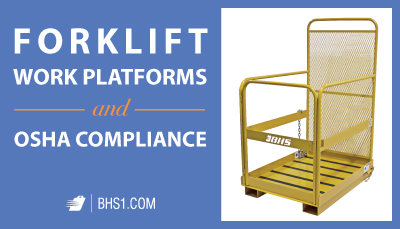
Aerial work can lead to emergency situations, which is why you need a safe, well-designed forklift work platform (also known as a "forklift man basket," "man basket," or "personnel basket.")
But given that forklift man baskets don't eliminate all risk on their own, it's no surprise that the Occupational Safety and Health Administration has quite a bit to say on the matter. In fact, at one point the federal agency even discussed banning the use of forklifts as a support for work platforms.
Ultimately, OSHA decided that safe operation of these elevated platforms was possible, provided that employers and staff followed the appropriate safety standards. The administration created a list of standards for the use of elevated personnel platforms, and if your operation is using forklift work platforms, it's important to understand those standards.
Here's a summary of some of the most important requirements for forklift work platforms (or, if you prefer, forklift man baskets.)
OSHA Forklift Man Basket Regulations
-
Never move a forklift horizontally while a worker is elevated. This is expressly forbidden by OSHA 451(c)(2)(v) and something that most operations avoid in the first place. Driving powered industrial trucks quickly with the mast up risks flipping the vehicle; this is dangerous even without an employee in a man basket. As one of the most important safety guidelines surrounding forklift man baskets, this information belongs in any operator training program.
-
Fully secure the work platform to the forklift truck. OSHA is clear that unstable platforms are unacceptable. The BHS Forklift Work Platform attaches via a Fork Tine Restraint integrated with universal-fit fork pockets. This mechanism locks the fork-mounted work platform to straight mast forklifts. An over-sized, quick-disconnect, heavy-duty steel pin allows workers to quickly secure or detach the platform without sacrificing safety. Meanwhile, a hook and safety chain mast restraint enhances safety at all working heights.
-
Use multiple safety mechanisms to secure workers on the forklift platform. Employing a platform with a sufficiently high guard rail and points for attaching safety devices (like a safety belt or harness) ensures that workers stay on the platform even when sudden or unexpected movements cause loss of balance. An anti-skid surface and highly visible colors also aid in safety, while expanded metal on the mast guard allow more visibility. Every added safety feature increases fall protection, and reduces the risk for injury or accidents.
-
Have written permission from the industrial truck manufacturer for the work platform. This is crucial, unless the operator manual explicitly states that the machine was designed to elevate personnel platforms. Warehouse managers can contact the manufacturer and request written permission, and most of them will comply. This may seem like an unnecessary hoop, but OSHA requires it through standard 178(a)(4). Once the manufacturer provides the letter, it's up to the warehouse manager to change data plates to account for the combined weight of the platform.
-
Use an appropriate work platform. The platform at the base of the forklift man basket should be "designed by a qualified person and...constructed and loaded in accordance with that design" as per OSHA §1926.451(a)(6). That includes sufficient load capacity for both the man basket and the operator. Buying equipment from trusted professionals ensures that the product was made with safety, durability, and compliance with regulations in mind.
Whether you view OSHA as an unnecessary complication, a necessary evil, or an essential source of safety standards, you still have to follow their job safety regulations. Listing them can help warehouse managers choose equipment that makes compliance simple, while still providing a rugged and practical product.
Elevated personnel platforms help complete a variety of tasks, but their use requires meeting a variety of requirements. Using experienced engineers who build equipment with regulations in mind is a great way to effortlessly meet those requirements.
References:
Andel, Tom. "Forklift Life Lesson #6: OSHA's Picky about How You Cage Workers." MHLNews. Penton, 13 Mar. 2014. Web. 8 June 2017.
Swanson, Russell. "OSHA Standard Interpretation Letter." OSHA. Occupational Safety and Health Administration, United States Department of Labor, 27 Nov. 2001. Web. 8 June 2017.
